

Closing the Loop: Pipeline Management and Solution-Oriented Leadership
Published on: Jun 24, 2026
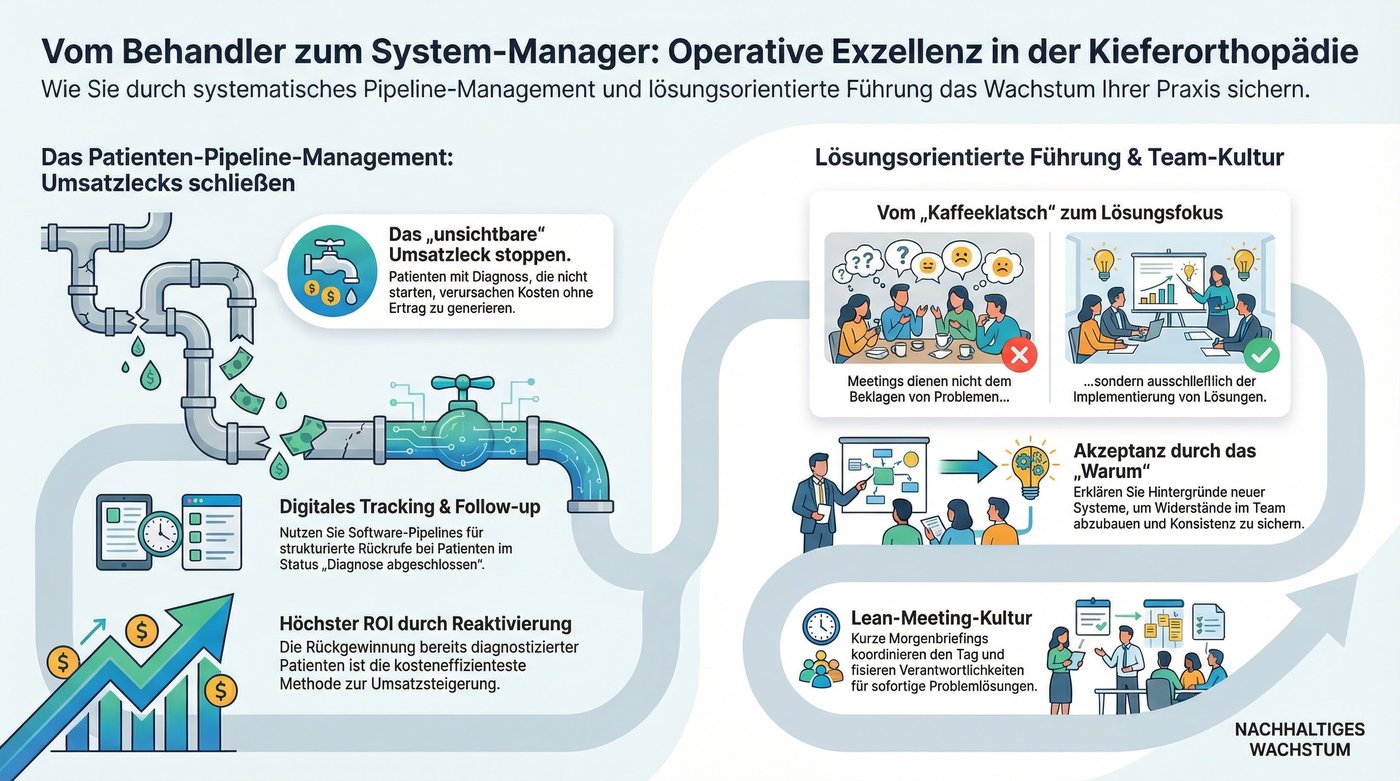
Managing a growing orthodontic empire requires a fundamental shift from a “chairside focus” to a “system focus.” In the early stages of a practice, a clinician’s primary concern is the technical excellence of the craft. However, in a busy multi-location environment, the biggest threat to your growth is not a lack of clinical skill or even a lack of new leads, but rather a leaky patient pipeline. When a patient completes a comprehensive diagnosis but never actually starts treatment, it represents significant lost revenue that has already consumed your clinical time and marketing budget.
To achieve true operational excellence, leadership must implement rigorous digital tracking and foster a culture of proactive, intentional communication. By managing your pipeline and your team meetings with lean precision, you can ensure that your expansion is both sustainable and stress-free. This transition allows the practice owner to move from being the primary producer to being the strategic architect of a high-performance healthcare organization that functions with or without their constant physical presence at the chair.
The Patient Pipeline: Stopping the “Invisible” Revenue Leak
In a single-location boutique practice, you might remember every patient by name and face. In a multi-location group, however, patients easily slip through the cracks of a complex administrative system. They receive a detailed diagnosis, hear the proposed treatment plan, and then… silence. They rarely say “no” to the treatment itself; they simply get busy, feel overwhelmed by the financial commitment, or simply forget to take the next step. This “invisible” leak is often the difference between a practice that is merely surviving and one that is thriving.
You must leverage a digital pipeline view in your management software (such as iVoris or Z1) to identify exactly who is sitting in the “Diagnosis Completed” stage but hasn”t moved to “Treatment Started.” A friendly, structured follow-up call from a well-trained treatment coordinator is the highest ROI activity in your practice. It costs almost nothing to reactivate a patient who has already been diagnosed, yet it generates immediate, high-value revenue. Leadership means ensuring no patient disappears into the void of administrative neglect, turning potential starts into realized growth through consistent, data-driven follow-up protocols.
Solution-Oriented Meetings: Ending the “Coffee Talk” Culture
As you expand your footprint, communication becomes your most vital strategic tool. However, many practices suffer from “meeting bloat”—unproductive gatherings where the team sits around, drinks coffee, and dwells on yesterday’s problems. This type of meeting culture is the antithesis of lean management. It drains energy and creates a cycle of frustration rather than a pathway to improvement. Effective leadership requires transforming these sessions into high-impact, decision-making forums.
A lean meeting culture is strictly solution-oriented. We use morning briefings to set a professional tone and coordinate the “who, what, and where” for the day ahead. If a problem is identified, the meeting’s only purpose is to implement an immediate or long-term solution. This requires significant preparation and a fundamental shift in mindset: we don”t just identify what went wrong; we agree on how to fix it so it never happens again. By focusing on root-cause analysis and actionable outcomes, you turn your team from a group of problem-reporters into a team of problem-solvers.
Training for Transition: Ensuring Team Buy-In
When you introduce a new system—whether it’s a high-tech intraoral scanner, a new CRM, or a radical new scheduling philosophy—you cannot simply hang a notice on the breakroom door and expect compliance. Change without proper training and context inevitably leads to resistance and sub-optimal utilization of the new tool. Leadership involves managing the emotional and technical transition of the people who will be using these systems every day.
To successfully manage multiple locations, you must explain the “why” behind the “what.” When your team understands that a new schedule means fewer empty gaps and a more predictable, less frantic workday, they will naturally support the shift. Invest the necessary time and resources to train your staff across all locations so that the culture and quality of care remain consistent, whether you are in your main hub or your newest satellite office. Training is not an expense; it is the essential insurance policy for your practice”s scalability and standard of excellence.
Summary: Building a Practice that Serves You
Ultimately, expansion shouldn”t mean more chaos; it should mean more freedom and impact. By focusing on cost control through professional management, optimizing clinical hours to meet actual patient demand, and rigorously managing your patient pipeline, you build a resilient structure that supports your long-term success. This leadership approach ensures that the business grows in value as an asset, rather than becoming a burden that requires more of your personal time as it scales.
Whether you run one practice or five, the core principles of solution-oriented leadership remain the same: identify the waste, close the revenue leaks, and lead with a structure that empowers your team. The goal is to stop serving your practice and start building a practice that serves your life and your vision for the future of orthodontic care. By closing the loop on every process, you secure your legacy and your lifestyle.