

“Chunking” and the “If-Then” Mindset: Simplifying Complex Orthodontics
Published on: Jul 5, 2026
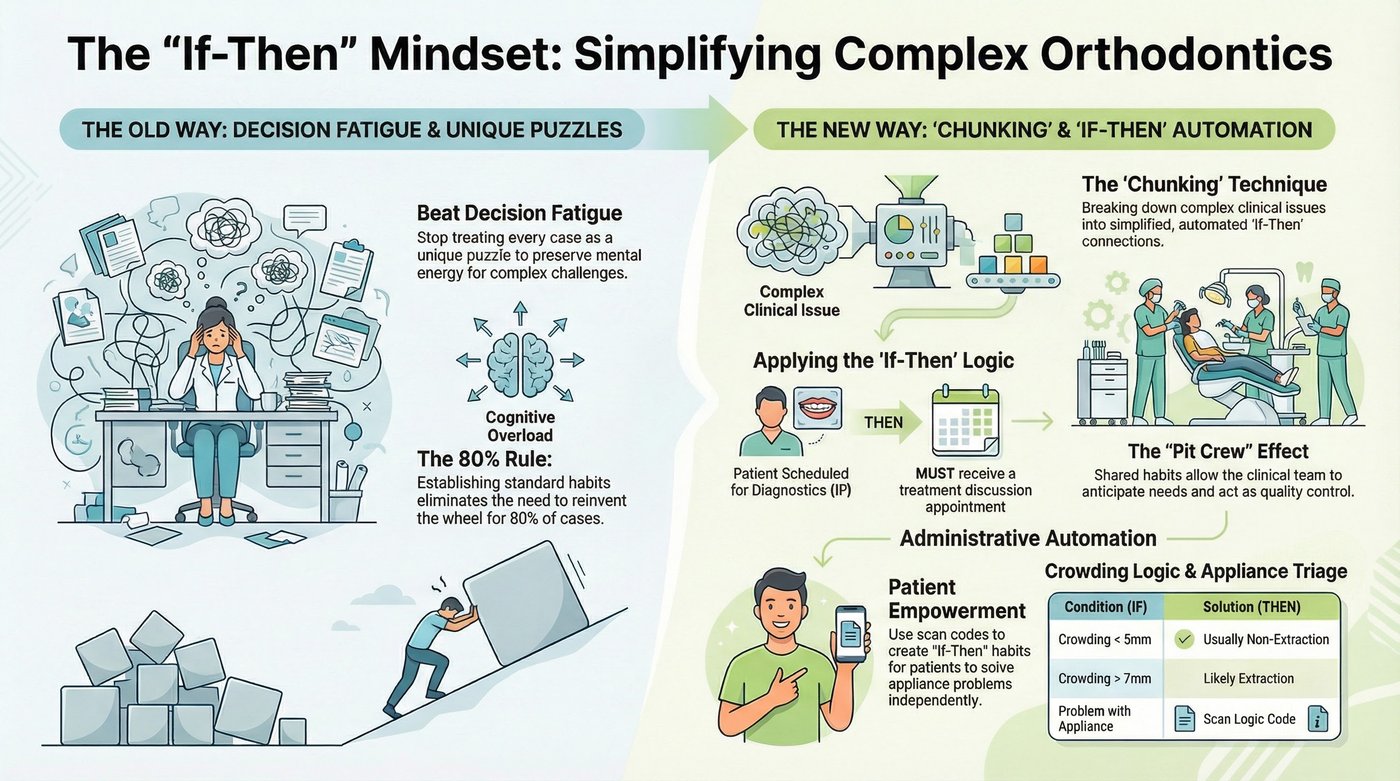
The Mental Load of Constant Decision-Making
One of the primary causes of exhaustion for orthodontic practice owners is “decision fatigue.” Every afternoon, we are faced with dozens of clinical math problems: How much space is needed? Should we extract? Is the midline correct? When every patient is treated as a unique, ground-up puzzle, we burn through our mental energy long before the day is over.
This daily exhaustion is a direct impediment to effective leadership. When doctors and practice owners are mentally depleted, strategic thinking suffers, often leading to reactive management and inconsistent clinical quality. Decision fatigue isn’t just about feeling tired; it is a measurable decrease in the ability to make rational, high-quality choices for complex cases. High-volume practices are particularly vulnerable to this gradual erosion of cognitive stamina.
To achieve operational excellence, we must utilize a cognitive technique known as “chunking.” This involves breaking down complex issues into simplified “If-Then” connections. By automating standard situations, we preserve our focus for the unique challenges that truly require our attention.
“Chunking” in the dental environment means establishing predictable protocols for high-frequency clinical scenarios. This allows the doctor to delegate the execution of the initial, systematic steps to the team, knowing that the diagnostic foundation is sound. We allocate our most valuable resource—cognitive capacity—only to the 20% of cases that present true diagnostic complexity or require bespoke mechanical adjustments.
The Logic of If-Then Connections
In lean management in dentistry, we create standard strategies for standard problems. This methodology focuses on maximizing value while minimizing waste—in this case, the wasted time and mental energy spent on repetitive decisions. The goal is to move from ad hoc, situational decision-making to a codified system of predictable pathways.
IF there is less than 5 mm of crowding, THEN the solution is usually non-extraction, involving IPR or minor expansion. This pathway minimizes chair time and leverages standard-issue archwires or aligner protocols.
IF there is more than 7 mm of crowding, THEN the solution is likely extraction or significant skeletal expansion, requiring immediate records and detailed consultation planning. This clear trigger allows the team to prepare necessary consent forms and plan appliance delivery.
The “If-Then” framework extends well beyond crowding. For instance, IF a patient presents with a deep bite (over 50% overlap) and severe occlusal wear, THEN the immediate mechanical strategy must include posterior bite turbos and rapid leveling with nickel-titanium wire sequencing. This standardization ensures complex mechanics are introduced at the optimal time without diagnostic delay or unnecessary mechanical adjustments.
By establishing these “If-Then” habits, you eliminate the need to reinvent the wheel for 80% of your cases. This isn’t about “cookbook” medicine; it’s about practice efficiency and maintaining a high standard of clinical care consistently. It allows the clinical team to anticipate the doctor’s needs, prepares the patient for the likely treatment path earlier in the journey, and significantly reduces the inherent variability that plagues inconsistent and high-turnover practices.
Scaling Team Performance Through Shared Habits
The most successful practices are those where the entire team shares the same “mental shortcuts.” This communal clinical vocabulary is the backbone of scaling operations without sacrificing quality or accuracy. By defining and training staff on key clinical and photographic endpoints, they transition from merely following instructions to actively participating in quality assurance.
When you train your staff in the “Baxmann Keys”—checking canine Class I, molar stability, and midline—they become your first line of quality control, identifying potential issues before they become treatment roadblocks. This proactive, systematic approach prevents costly course corrections late in treatment and enhances the predictability of outcomes. It shifts the burden of meticulous detail away from the doctor and onto the structured operational process itself.
If an assistant notices a midline deviation before you even reach the chair, for example, they have already begun the diagnostic process by preparing the necessary auxiliaries, such as specific elastic chains or power arms. This shared habit improves dental team performance by eliminating wasted discussion time and ensuring seamless handoffs between patient visits. It moves the practice from a “one-man show,” which is inherently limiting, to a high-performing pit crew where everyone is looking for the same markers of success and is empowered to pre-stage solutions. This is the essence of a leveraged, systematized practice.
Enhancing the Patient Experience through Administrative Habits
The “If-Then” mindset should extend far beyond the operatory and deep into your front office, where communication, conversion rates, and retention are paramount. Administrative “chunking” ensures that no revenue or relationship opportunities are overlooked simply due to human oversight or poor system design.
For example: IF a patient is scheduled for diagnostics and records, THEN they must automatically receive the treatment discussion appointment scheduled within seven business days, with a pre-loaded, preliminary financial package review. This removes the “administrative ballast” of forgotten follow-ups and ensures the patient journey is seamless, drastically increasing case acceptance rates by maintaining decision-making momentum.
Another crucial administrative habit involves insurance verification and financial transparency. IF the patient’s submitted plan has orthodontic coverage benefits, THEN the finance coordinator automatically schedules a mandatory pre-treatment call to walk them through the projected out-of-pocket costs and payment options. This proactive financial transparency builds indispensable trust and prevents last-minute surprises that can derail a committed patient.
We even apply this structured logic to appliance troubleshooting and after-hours care. By providing patients with digital logbooks and scannable QR codes for removable appliances, we create an “If-Then” habit for the patient: IF you have a problem (e.g., lost aligner, broken retainer), THEN scan this code for the immediate solution, including video instructions or a link to an emergency triage form. This system reduces unnecessary inbound phone calls by solving 90% of routine issues, empowers the patient by giving them immediate answers, increases their satisfaction, and significantly reduces your administrative and on-call team’s workload.
Conclusion: The Path to a Proactive Practice
Excellence in orthodontics is not achieved through heroic effort but is the result of many small, positive habits executed consistently and reinforced systemically. The strategic implementation of “chunking” and “If-Then” logic transforms a high-stress, unpredictable clinical day into a predictable, manageable series of standardized protocols.
By establishing these reliable frameworks, practice leaders reduce the chaos of the clinic and lead with clarity, shifting their role from a perpetually exhausted operator to a strategic commander focused on growth. This structural way of working allows you to sustain a high-performing practice volume without sacrificing your personal well-being or the quality of patient care. Start identifying your operational and clinical “triggers” today and proactively build the routines that will lead your practice to a successful, sustainable, and autopilot future, ensuring longevity and consistent profitability.