

Building a Self-Managing Team: The Lean Path to Clinical Freedom
Published on: Jun 22, 2026
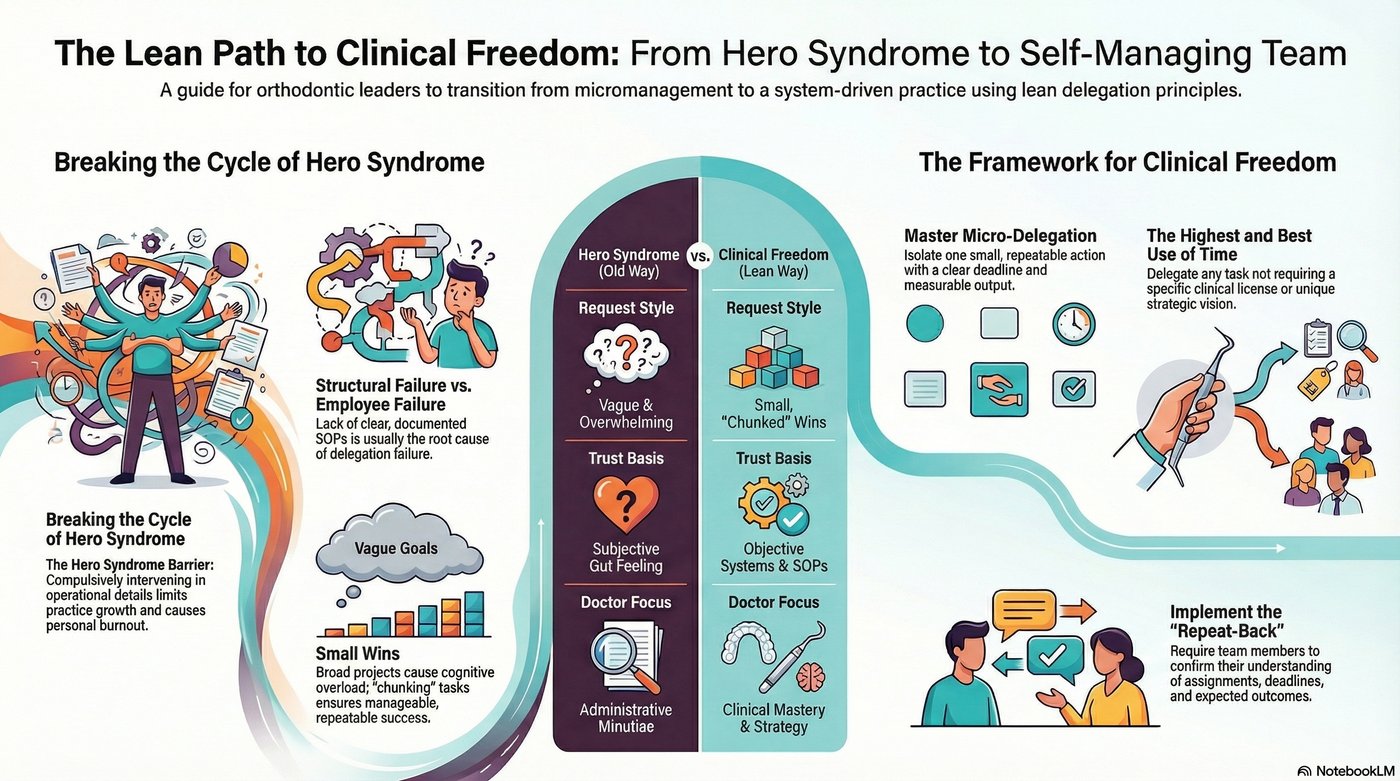
The goal of every orthodontic leader should be to build a practice that functions at a high level without the doctor’s constant supervision. This state of “autonomy” is not reached by hiring better people; it is reached by building better systems of trust and delegation. The common challenge for many high-performing clinicians is the “Hero Syndrome,” where they feel compelled to personally intervene in every operational detail. This approach is ultimately a massive limiter on practice growth and personal burnout.
Many clinicians are trapped in a cycle where they give a huge, overwhelming task, the employee fails, and the doctor uses that failure as proof that “nobody can do it as well as I can”. This reactive stance masks a fundamental design flaw: the lack of clear, documented Standard Operating Procedures (SOPs). Trust in delegation is not about gut feeling; it is built upon the foundation of accessible, reliable systems that standardize performance.
This is a structural failure. To lead a lean team, you must break down complex goals into “small wins”. A lean methodology, in this context, minimizes the waste of time, effort, and corrective energy by ensuring every task is manageable and repeatable. By mastering the art of micro-delegation, you build the “muscle memory” of success within your staff, allowing you to gradually step away from the administrative minutiae and focus on clinical mastery. This strategic shift is what transitions a clinician from being a busy operator to a true business leader.
The Strategy of the “Small Win”
If you delegate a massive project like “Organize the new marketing campaign,” you are setting the employee up for failure. The cognitive load is too high, and the objective is too vague. Such requests lack clear parameters and are often perceived as overwhelming by the recipient, leading to delays or incomplete execution. This is a common pitfall in practices transitioning to a growth mindset.
In a lean practice, we apply the principle of “chunking” to our delegation. This involves isolating one small, repeatable action with a clear deadline and measurable output. For example, instead of the vague marketing request, a doctor could start with a single, manageable piece: “Please research three local printing companies by Friday, comparing their turnaround times and minimum order quantities”.
When the employee succeeds with this small task, you praise them. This acknowledgment must reinforce the system that enabled the success, not just the individual’s effort. This success builds their confidence and, crucially, builds your trust in them, validating the documented process you provided. This intentional compounding of small wins is how you nurture future leaders.
Over time, these small wins compound into the ability to handle larger responsibilities. We recommend utilizing a “Delegation Log” or simple tracking system to monitor a team member’s successful completion of micro-tasks. This data-driven approach replaces subjective judgment with objective performance metrics, allowing team members to take ownership of entire “Main Processes” like optimizing the inventory management system or streamlining insurance verification. You are not just getting a task done; you are developing a leader who understands accountability and process execution.
Delegating for Performance, Not Procrastination
Delegation is often misused as a way for the doctor to avoid uncomfortable tasks. While tempting, using delegation as a form of avoidance undermines its true purpose in a high-performance setting. The highest value of this tool is strategic optimization.
However, in a lean practice, delegation is a tool for operational efficiency. Operational efficiency is measured by maximizing the time the clinical leader spends on activities that require their specific, licensed expertise or unique strategic vision. You should delegate anything that does not require your specific clinical license or your unique strategic vision.
Ask yourself: “Is this task the highest and best use of my time as an orthodontist?”. If the answer is no, it should be delegated using the seven-question framework. This framework ensures the task is fully defined, includes clear boundaries, and specifies the expected result. The opportunity cost of a doctor spending time on “auxiliary processes,” such as ordering routine supplies or managing the social media calendar, is significant. Every moment spent on low-value tasks is a moment lost for high-impact treatment planning, complex biomechanics, or engaging with key referral partners.
By clearing your own schedule of these auxiliary processes, you reclaim the mental energy required for high-impact treatment planning and complex biomechanics. This clarity enables you to lead proactively rather than reactively. This is how a lean practice grows: by ensuring the leader is always focused on the “Main Processes” that drive value for the patient and profitability for the clinic. When delegation is systematic, it directly translates to increased chair time efficiency and reduced overhead through streamlined workflows.
The Homework for Leadership Growth
Transforming your practice into a self-managing machine starts with a single, disciplined act. Pick one task tomorrow—one you usually do yourself because “it’s just faster”— and delegate it. This initial push-back against the status quo is the most crucial step in the leadership journey.
Follow the seven questions. Use positive instructions. Avoid phrases like “Don’t mess this up” and instead focus on “The goal is to achieve X standard result.” Most importantly, ask for the “repeat-back,” requiring the team member to confirm their understanding of the assignment, the deadline, and the expected outcome. This closed-loop communication system prevents misinterpretation and establishes mutual accountability from the start.
When the employee delivers that first result, celebrate it. Should minor errors occur—and they will—view them as “system learning opportunities,” not individual failures. This response is vital for maintaining the culture of trust you are building. Every successfully delegated task is a brick in the wall of your clinical freedom. This freedom allows you to shift your focus to strategic growth, clinical research, or simply a better work-life balance, ultimately driving long-term retention of both staff and patients.
Conclusion
Achieving clinical freedom is not a sudden event, but the cumulative result of intentional, disciplined delegation built on a framework of lean systems and small, measurable successes. Orthodontic leaders must shift their perspective from doing every task to designing the system that ensures all necessary tasks are completed efficiently by a trained team. By committing to micro-delegation today, you invest in the self-sufficiency of your team, positioning your practice for sustainable, high-level performance and securing your role as a true, strategic leader. Stop being a prisoner of your own processes and start building a team that empowers your practice to reach its full potential.