

Beyond the Volume Trap: Engineering Fulfillment Through Core Values
Published on: Jul 2, 2026
The Paradox of the Busy Clinic
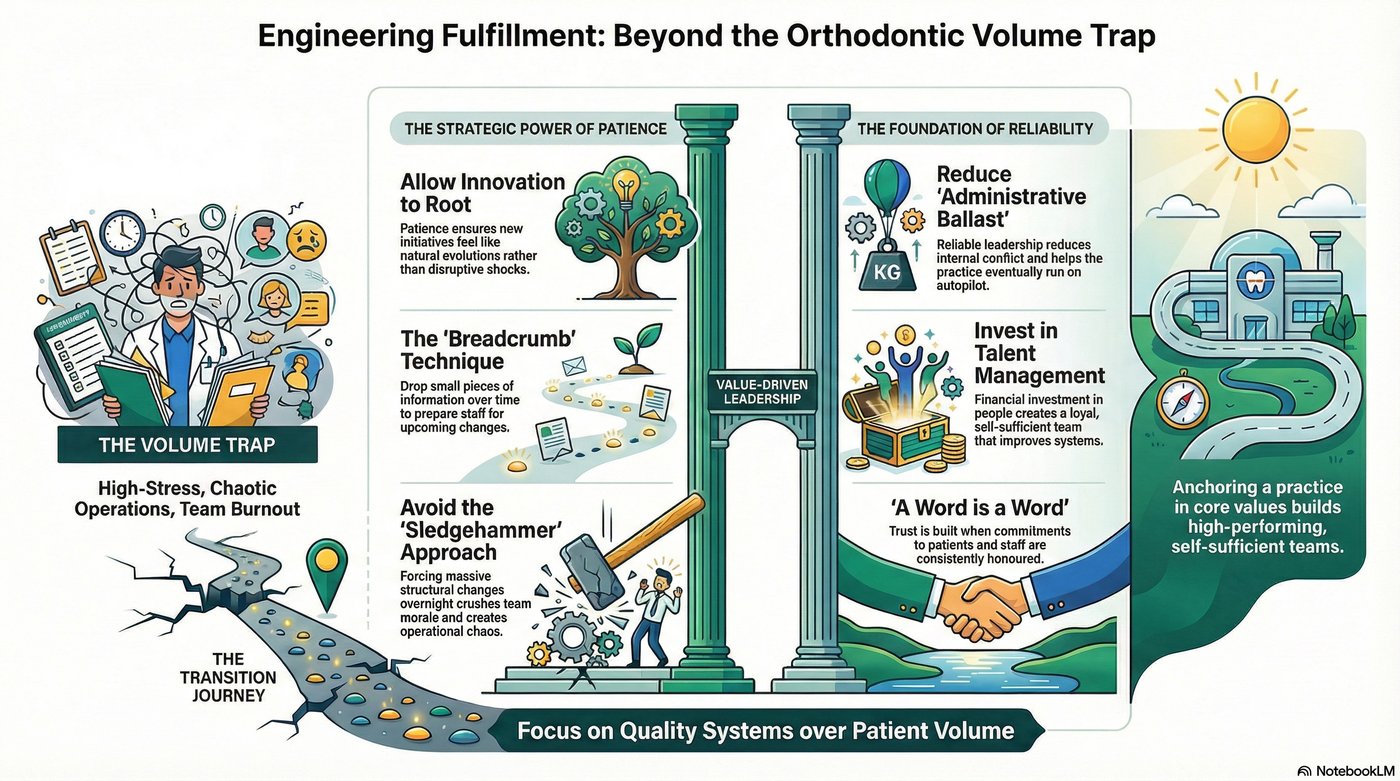
Many orthodontists fall into the trap of equating success with high patient volume. We push for more chairs, faster appointments, and packed schedules, only to find that our personal satisfaction is at an all-time low. When we prioritize sheer speed over the quality of our human interactions, we create a high-stress environment that leads to burnout. This relentless focus on throughput often sacrifices team cohesion and long-term patient relationships for short-term revenue gains.
The volume-centric model creates unnecessary strain on support staff, forcing them to rush critical tasks and making error correction a constant drain on resources. True efficiency is not about speed; it’s about minimizing waste and maximizing value delivered to the patient.
In lean orthodontics, we recognize that true success is not measured by how many patients you see, but by the quality of the systems and values that sustain the practice. These systems create reliable, repeatable outcomes that reduce administrative overhead and stress for everyone.
To achieve lasting professional joy, we must move away from a “survival” mindset and anchor our practice in four core values: patience, reliability, empathy, and gratitude. These are not just “soft skills”; they are the structural pillars of operational excellence and a high-performing team.
The Strategic Power of Patience
In a world that demands instant results, patience is a competitive advantage. It allows leaders to implement change thoughtfully and cultivate a culture of psychological safety, where staff feel comfortable identifying process flaws without fear of retribution.
When a leader tries to force massive structural changes overnight—like a sudden transition to a fully digital workflow—they often crush the team’s morale. This “sledgehammer” approach creates chaos rather than progress and often results in costly, failed rollouts that must be reversed.
A lean leader uses the “breadcrumb” technique. Instead of a total overhaul, you drop small pieces of information over time to prepare your team for change. This might involve scheduling short, focused training sessions over several weeks rather than a single 8-hour marathon.
By being patient with the learning curve of your staff, you ensure that when you finally “pull the trigger” on a new initiative, it feels like a natural evolution rather than a disruptive shock. Patience also applies to clinical results; rushing treatment compromises case quality and ultimately leads to more chair time correcting mistakes.
Patience in dental leadership allows innovation to take root properly, ensuring long-term practice efficiency. This measured pace fosters deep understanding and complete buy-in from the entire clinical and administrative staff.
Reliability: “A Word is a Word”
The foundation of any high-performing system is trust. Reliability means that a word is a word—whether it is a promise made to a patient or a commitment to a staff member. This consistency translates directly to the practice’s brand equity and referral rates.
If you assign a complex task but never make time for the promised feedback, you are breaking the system. A breakdown in leader reliability signals to the team that commitments are optional, eroding the standard for accountability across the entire practice.
Reliability also extends to talent management. Investing in people, even when it presents an initial financial burden, pays off in the form of a loyal, self-sufficient team. For example, funding advanced training for a clinical assistant shows concrete, reliable support for their professional growth.
Furthermore, structured protocols are an expression of reliable operations. When appointment times, sterilization processes, and charting procedures are consistently followed, patients experience a predictable, high-quality service, reducing anxiety and increasing compliance.
When your staff knows they can rely on your word, they are more willing to take initiative and adopt the “Lean Eye” needed to improve the practice from within. This reliability is what allows a practice to eventually run on autopilot, freeing the leader to focus on strategic growth rather than daily management.
Conclusion: Value-Driven Leadership
By anchoring your practice in patience and reliability, you create a stable environment where both the team and the business can grow. This stability is amplified by the third pillar, empathy.
Empathy is the ability to understand and share the feelings of both the patient and the staff. Clinically, it means recognizing patient discomfort or anxiety and adjusting the treatment approach accordingly. Internally, it means anticipating staff stress points, such as an overwhelming workload or a conflict with a colleague, and proactively addressing them through schedule adjustments or mediation.
The final, indispensable core value is gratitude. Regularly expressing authentic thanks—not just for results, but for effort and adherence to values—cements team loyalty. A leader who shows gratitude fosters a positive feedback loop that reduces the “administrative ballast” of internal conflict and missed expectations.
When you lead with a clear moral compass, founded on these four core values, you find that the practice doesn’t just become more profitable—it becomes more fulfilling. This value-driven approach is the ultimate form of sustainable competitive advantage.