

Beyond the PowerPoint Marathon: Engineering Engaging Digital Education
Published on: Jun 28, 2026
The “Webinar Fatigue” Crisis
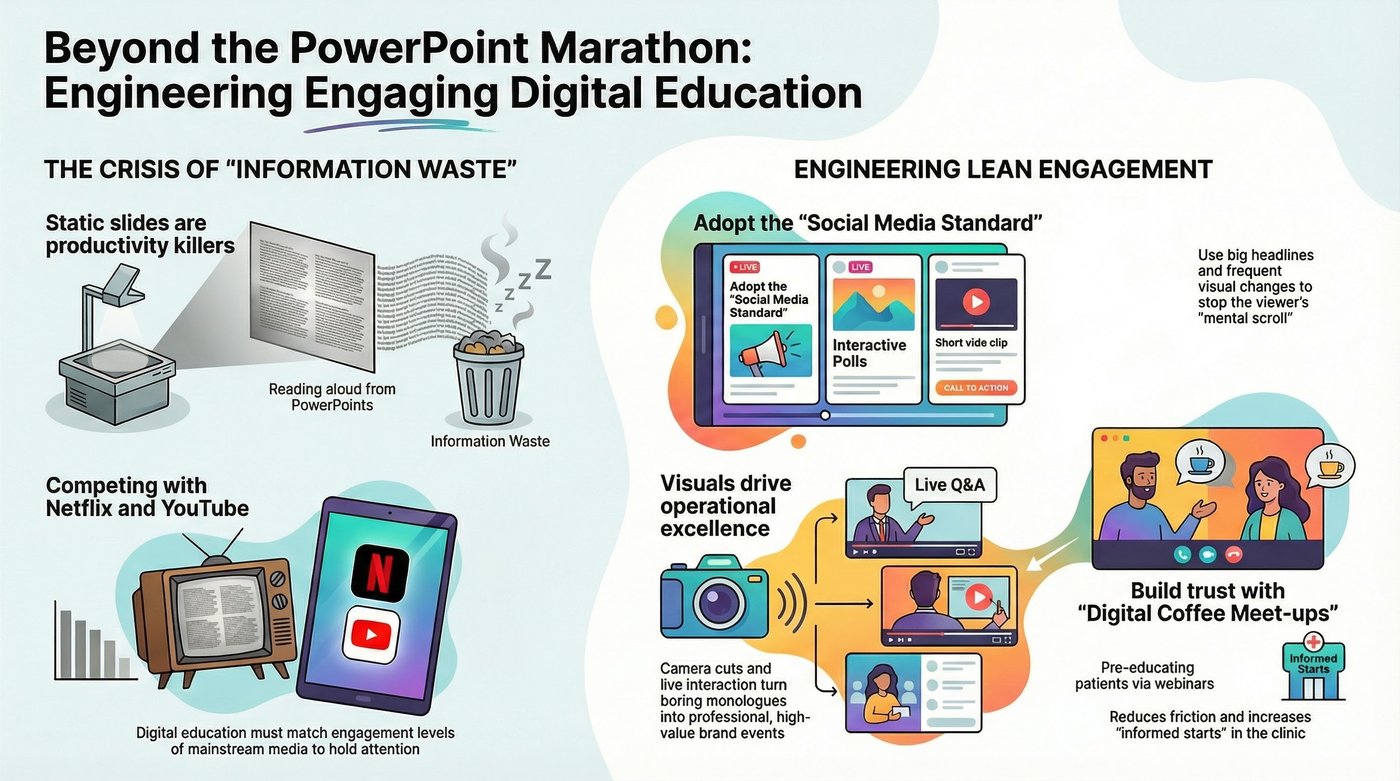
In the modern orthodontic world, online learning has become a staple. However, most of these offerings are a productivity killer: static PowerPoint slides being read aloud by a speaker who is barely visible in a small box.
For a high-performance practitioner, this format is a form of “information waste.” In lean orthodontics, we recognize that education must be as efficient as a clinical procedure. We are no longer competing with other dental lectures; we are competing with YouTube and Netflix.
If you want to use online courses to grow your practice or train your team, you must move beyond the “read-aloud” format. When a lead assistant watches a blurry 60-minute video to learn a 5-minute bonding protocol, you are burning overhead and disengaging your best talent.
True leadership requires respecting the viewer’s time. An engaging digital experience should feel like a high-end documentary, not a legacy university lecture. If the content doesn’t capture attention in the first 30 seconds, the educational value drops to zero regardless of the speaker’s credentials.
The Visual and Bite-Sized Standard
Our brains are wired for visual, dynamic information. To achieve operational excellence in your digital education, you must adopt the “Social Media Standard.” This means using big headlines, fast-paced delivery, and frequent visual changes to stop the “mental scroll” of your audience.
Consider the “10-second rule”: if the visual on screen hasn’t changed in ten seconds, the viewer’s mind begins to wander to their inbox or their next patient. Use multi-camera setups or screen-sharing that toggles between the speaker’s face and high-resolution clinical photos.
If you expect a colleague or a patient to sit in front of a screen, the content must be packaged in a way that feels like a dialogue. Break down long-form topics into “chapters.” A deep dive into Class II correction is better served as six 8-minute modules than one exhausting hour.
Even an eight-hour seminar can be engaging if you incorporate camera cuts, live Q&A sessions, and high-quality graphics. This approach turns a “yawning” session into a professional event that enhances your brand as a leader and entrepreneur.
In your practice, this might look like a “Video SOP Library.” Instead of a thick manual, your team accesses 2-minute clips demonstrating exact tray setups. This reduces training friction and ensures that your “Standard Operating Procedures” are actually followed and understood.
Building Patient Trust via “Digital Coffee Meet-ups”
The same principles apply to the patient journey in orthodontics. In the past, informing prospective patients about complex treatments like clear aligners or lingual braces might have required in-person seminars or long chairside explanations.
Today, a well-produced, entertaining webinar—a “Digital Coffee Meet-up”—allows patients to get to know you and your team from their own homes. It removes the clinical intimidation factor and replaces it with a personal connection before they even arrive.
This establishes your authority before they ever step foot in your clinic. When a parent watches a 15-minute “What to Expect” video that is visually crisp and easy to follow, they develop trust in your technological sophistication.
It reduces the “friction” of the consultation process because the patient arrives pre-educated and pre-motivated. By making the information lean and accessible, you turn “cold” inquiries into warm, informed starts, increasing your practice efficiency on autopilot.
The “Sales Funnel” in a modern practice relies on this digital pre-conditioning. If your online presence looks like a dated PowerPoint, patients may assume your clinical technology is equally behind the times. High-quality digital education is a direct reflection of your clinical standards.
Conclusion: Entertainment as an Educational Tool
Digital learning is not a “lite” version of in-person training; it is a specialized tool that requires a different skill set. By focusing on visual communication and “entertainment value,” you ensure that the knowledge actually sticks. When education is lean, it becomes something your team and patients look forward to.
The ultimate goal is “Knowledge ROI.” Every minute spent watching your content should return a tangible improvement in clinical skill or patient conversion. If you can deliver that through engaging, bite-sized, and visually superior media, you move from being just a doctor to a true innovator.
Stop the marathon and start engineering experiences. Your practice’s growth depends on how well you can capture the attention of a distracted world. In the end, the most engaging educator always wins the most loyal patients and the most efficient team.