

Beyond the Plastic: The 4D Revolution and the Future of Shape-Memory Aligners
Published on: Jun 22, 2026
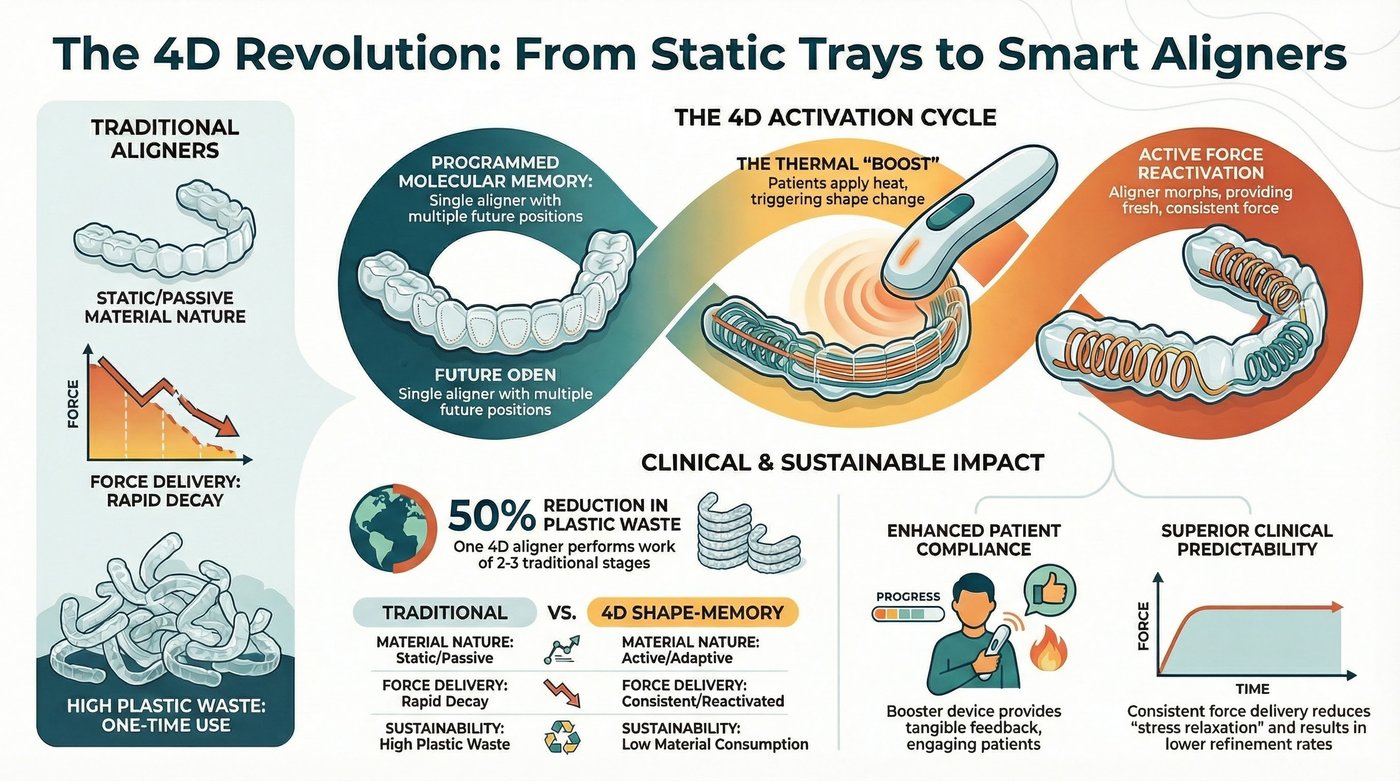
In the world of clinical orthodontics, we have spent decades treating clear aligners as static, passive objects. We move a tooth by 0.2mm, throw away the plastic, and replace it with another static tray. This conventional approach, while effective, embodies significant process waste. From a lean management perspective, this constant cycle of disposal and replacement is remarkably inefficient. It necessitates high material throughput and complicates inventory management for high-volume practices.
The reliance on an incremental “push” system often results in compliance lag and unpredictable tooth movement, requiring additional appointments for mid-course corrections. Forward-thinking clinic leaders must now challenge this outdated material paradigm to achieve true operational excellence and superior patient outcomes.
We are now witnessing the most significant breakthrough in material science since the introduction of the digital scan: 4D technology. By introducing “time” as the fourth dimension through shape-memory polymers, we are transforming the aligner from a static retainer into an active, intelligent medical device. This shift is a fundamental redesign of the entire orthodontic patient journey, promising higher predictability and a simplified clinical workflow.
The Science of 4D: Shape Memory and Thermal Activation
Traditional aligners are thermoformed or printed in a single, final shape. The initial biomechanical force, which is critical for initiating cellular response, begins to decay almost immediately due to stress relaxation and creep within the polymer. This sharp drop-off in force necessitates the rapid exchange of trays, often every seven days, to maintain a consistent load on the periodontal ligament.
4D technology, popularized by innovations like ClearX, fundamentally changes this force delivery dynamic through “programmed” memory. These advanced materials, known as shape-memory polymers (SMPs), are capable of storing multiple geometric conformations within their molecular structure. The first, or temporary, shape is worn by the patient, initiating the required tooth movement.
A patient wears the aligner for the first specified duration. Instead of switching trays, they utilize a specialized at-home “Booster” device. This device delivers a controlled thermal stimulus, precisely heating the polymer to its unique glass transition temperature (Tg). This thermal exposure is high enough to trigger the material’s programmed “memory,” yet remains safe and comfortable for the patient.
The aligner physically morphs into its next programmed shape in a matter of minutes. This activation effectively transforms the original piece of plastic into a “new” aligner stage, optimizing the active force window without generating any additional plastic waste.
Reducing Waste and Enhancing Sustainability
The environmental impact of traditional aligner therapy is a growing concern for both practitioners and patients, directly impacting a clinic’s corporate responsibility profile. A standard full-arch treatment might involve forty to sixty individual aligners, a significant volume of non-biodegradable plastic destined for landfills.
The 4D model is a paradigm shift in material economics, allowing a single physical aligner to perform the work of two or three traditional stages. This capability translates directly into fewer manufacturing runs and a reduced carbon footprint for the overall case.
For a lean practice, a 50% reduction in material consumption is a massive gain in operational efficiency. It drastically simplifies logistics, minimizes required storage space, and reduces administrative time spent tracking and dispensing multiple trays. Adopting 4D technology immediately positions your clinic as a leader in “Green Dentistry,” a powerful value proposition that builds unshakeable trust with sustainability-minded patients.
Boosting Patient Compliance Through Engagement
One of the most persistent challenges in orthodontic practice management is consistent patient compliance. Traditional aligners create a passive experience; the only requirement is swapping one inert tray for the next on a fixed schedule. This lack of engagement often leads to a gradual decline in adherence during the lengthy middle phases of treatment.
4D technology elegantly solves this by turning the patient into an active, hands-on participant in their own transformation. The act of using the “Booster” provides immediate, tangible proprioceptive feedback—the sensation of tightening and renewed force. This direct evidence that the treatment is working acts as a powerful psychological “reward” mechanism, significantly increasing compliance rates compared to purely passive systems.
These sophisticated systems are often integrated with mobile apps that track the “boost” cycles and overall wear time. This creates a real-time, data-driven window into the patient’s adherence to the protocol, moving beyond unreliable self-reported compliance. This implementation of the Internet of Medical Things (IoMT) ensures the patient’s biology and the mechanical plan remain perfectly synchronized, minimizing the risk of deviation.
Clinical Predictability and the Expert Mindset
From a clinical perspective, the most compelling advantage of 4D aligners is the delivery of a more consistent and optimized force system. Traditional aligners exhibit exponential force decay; by the end of the wear time, the applied force is often sub-optimal or even ineffective. Because the 4D material is “reactivated” halfway through its cycle, the applied force curve is flatter and more sustained than with conventional thermoplastics.
This sustained, optimized force leads directly to more predictable and physiologically sound tooth movements, resulting in a lower refinement rate. Reduced refinement cases translate into fewer chair-time hours, lower overhead costs, and significantly improved patient satisfaction, directly boosting your practice’s profitability.
Conclusion:
As a leader, mastering these “smart materials” allows you to transition your service model. You are no longer operating a traditional “Guru on the Stage” practice that relies purely on incremental physical materials. Instead, you are providing a high-tech, adaptive orthodontic system that respects the patient’s biology and the environment. The true future of orthodontics is not about 3D printing more plastic—it is about intelligently programming and activating smarter plastic. Embrace the 4D revolution to solidify your expert mindset and lead your practice into the next dimension of clinical excellence.