

Beyond the Fruit Basket: Engineering Employee Motivation for Practice Growth
Published on: Jun 12, 2026
When orthodontic practice owners realize they have a morale problem, they often reach for “stylistic” fixes: a new espresso machine, a fruit basket in the breakroom, or a company outing. While these gestures are kind, they rarely address the deep-seated psychological needs that drive long-term employee loyalty. In the modern market, competing for talent requires a more sophisticated approach to dental leadership.
The reality is that transient perks offer fleeting satisfaction; they do not build retention. Leaders must recognize that their staff operates under a psychological contract, expecting growth and meaning in exchange for dedication. Ignoring this deeper layer of expectation leads to high turnover and the continuous, costly cycle of retraining new team members.
A strategic leader treats team motivation as a key performance indicator (KPI), requiring structured intervention rather than simple gestures of goodwill. To systematically exceed expectations—both for patients and staff—we must apply the same analytical tools we use for clinical diagnostics.
By using frameworks like Maslow’s Hierarchy of Needs or the Kano Model, we can move beyond generic perks and start engineering a culture of genuine motivation and professional growth. This analytical rigor transforms staff management from an art into a repeatable, sustainable system.
Deconstructing Motivation: Maslow and the Kano Model
Every member of your team has different drivers. To manage them effectively, you must understand their individual “buying motives.” For one employee, status and a high gross salary might be the primary motivator. For another, it might be the need for social harmony or a sense of contributing to a meaningful mission. Recognizing this diversity is the first step toward personalized management.
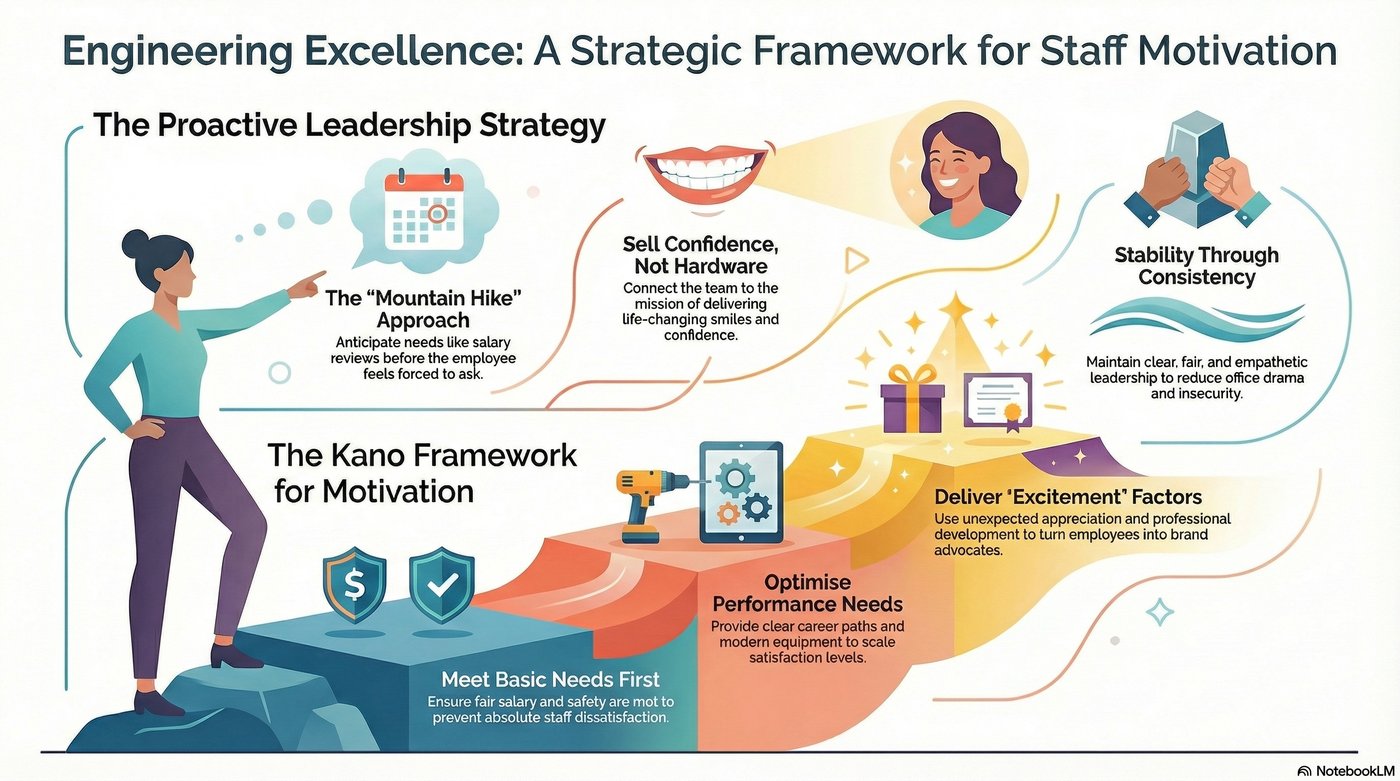
Applying the Kano Model to your staff allows you to categorize these needs and guide your investment decisions:
Applying the Kano Model to your staff allows you to categorize these needs:
Basic Needs: A fair salary paid on time and a safe work environment. If these aren’t met, dissatisfaction is absolute. For a dental practice, this includes state-of-the-art sterilization protocols and competitive hourly wages benchmarked against the local market. Failure here immediately triggers an employee search for new opportunities.
Performance Needs: Clear career paths, modern equipment, and efficient workflows. The better these are, the higher the satisfaction. Providing structured continuing education budgets or mentorship opportunities satisfies the need for professional advancement. Up-to-date practice management software and well-maintained clinical tools ensure that staff can perform their duties without frustrating bottlenecks.
Excitement Needs: Unexpected appreciation, spontaneous time off, or professional development opportunities. These are the “wow” factors that turn employees into advocates for your practice. Examples include publicly recognizing an assistant for outstanding patient rapport or funding attendance at a national specialty conference. These unexpected investments demonstrate a profound commitment that builds fierce loyalty.
The Mountain Hike Analogy: Proactive Leadership
Effective practice management requires anticipating the needs of your team before they become a source of conflict. I compare this to preparing for a mountain hike. You don’t wait until you’re shivering at the peak to look for a scarf; you pack it before you leave the house. This foresight minimizes reactive crises and allows the practice to operate smoothly.
Proactive leadership means anticipating salary reviews or role changes before the employee feels the need to ask. Instead of waiting for a team member to submit their two-week notice, a smart leader identifies high performers and proactively proposes a new title or compensation package. For example, implementing cross-training for key roles prevents operational panic when a staff member inevitably leaves.
When you see an employee doing excellent work and surprise them with appreciation on your own initiative, you build a bond that is far stronger than any reactive reward. It demonstrates that you are paying attention to their individual journey and valuing their contribution to the practice’s success. This genuine, unsolicited recognition creates psychological safety and reduces pressure.
Connecting the Team to the Mission
In lean management, we focus on the “Value Stream”. Our actual product in orthodontics is not just a piece of hardware or a specific bracket system. Our product is the confidence that comes with a life-changing smile. This transformation must be the central focus of all team activity, ensuring every task links back to patient value.
When a team member understands that their work leads to a patient’s greater success and happiness, their daily tasks take on a new level of meaning. For the front desk, this means viewing efficient scheduling not as administrative work but as respecting the patient’s time on their journey to a new smile. A team that stands behind the mission is naturally more engaged.
They don’t just “show up”; they represent the practice’s values at every touchpoint. This sense of purpose is a powerful antidote to burnout. It transforms the clinic from a place of labor into a center of transformation. Mission-driven engagement reduces clinical errors and fosters a collective responsibility for patient outcomes.
Leadership Consistency in Times of Crisis
Finally, true employee satisfaction is rooted in the security of clear leadership. Even when facing difficult situations—such as a colleague’s long-term illness or economic shifts—the leader must remain the steady hand. Consistency provides safety. Employees look to the leader during uncertainty; panic or indecision at the top will cascade rapidly through the team.
By being a clear, direct, and empathetic leader, you ensure that the practice remains stable. This involves establishing and adhering to transparent policies for everything from sick leave to handling challenging patient interactions. Inconsistent application of rules, especially concerning high-performers versus others, is a swift morale killer.
Employees are most satisfied when they know what is expected of them and see that the rules are applied fairly and consistently. This operational excellence reduces the “invisible waste” of office drama and internal politics, allowing everyone to focus on delivering an exceptional patient experience. A reliable leadership structure is the foundation of commitment.
Conclusion: Engineering a Raving Fan Team
Employee satisfaction is the silent engine of the patient journey. It directly impacts the energy and warmth patients feel upon entering the clinic, influencing their perception of quality far more than expensive décor. When you move beyond generic incentives and start addressing specific motivational drivers, you create a culture that is difficult to replicate.
The result of this investment is a powerful “win-win-win”. Your team feels valued and energized, leading to reduced turnover and higher clinical standards. Your patients feel welcomed and cared for, boosting positive reviews and referral rates. Finally, your practice thrives through increased efficiency and sustainable growth. Stop guessing what your team wants and start engineering a culture today.