

Beyond the Apology: Leading Through Failure with Active Resolve
Published on: Jun 28, 2026
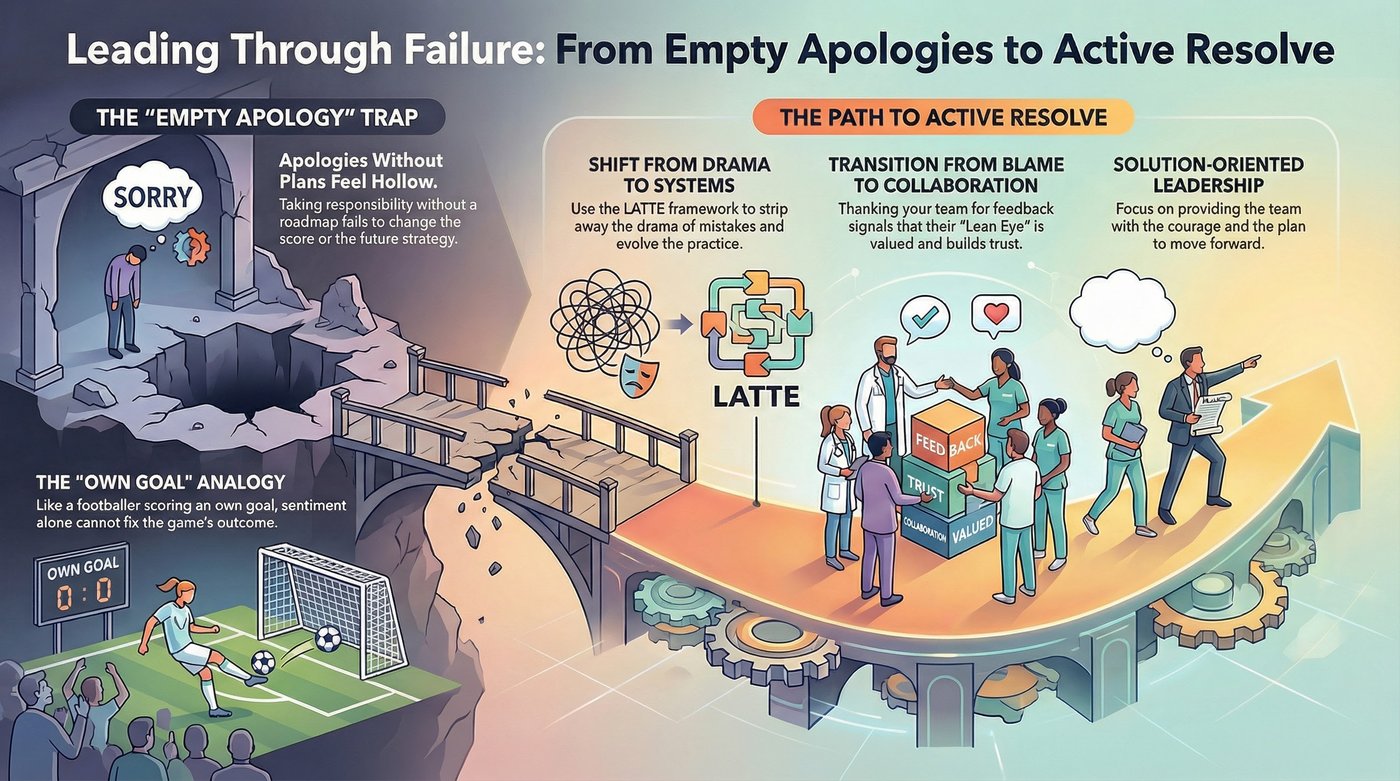
The “Empty Apology” Trap
In modern leadership, it has become fashionable to “take full responsibility” when a decision fails. We see it in politics and professional sports: a leader stands up, asks for forgiveness, and admits they were wrong. However, for the team on the ground, an apology without a plan often feels hollow. It’s like a footballer apologizing for an own goal; the sentiment is nice, but it doesn’t change the score or the strategy for the next game.
Consider a practice leader who implements a new, cost-saving inventory system that causes critical supply delays, stalling quadrant dentistry or clear aligner fittings. Simply stating, “I take full responsibility for the stock error,” does nothing to resolve the immediate clinical backlog or the team’s frustration. The apology addresses the leader’s feeling but ignores the operational consequences.
In lean orthodontics, we view mistakes differently. A leader’s primary job is not to dwell on past failures but to provide the team with the courage and the roadmap to move forward. A passive admission of fault only focuses on the past. An active resolve, conversely, shifts energy to mitigating risk and redesigning the faulty system.
To achieve operational excellence, you must transition from passive apologies to active, solution-oriented leadership. This means immediately initiating a root cause analysis, protecting the clinical schedule, and communicating a concrete plan for correction. In the highly systematic world of dental practice, any failure represents a system flaw, not a moral failing.
The LATTE Framework for Decision Reversals
When a major management decision—like a new scheduling system or a complex clinical protocol—doesn’t go as planned, you need a more elegant way to pivot than a standard “I”m sorry”. This is where the LATTE concept becomes your most valuable tool for dental leadership.
The LATTE framework provides a structured pathway to navigate high-stakes decision reversals with authority and clarity. It stands for: Listen, Apologize (for the impact, not the intent), Thank (the feedback provider), Take Action, and Explain the fix. This structured approach prevents the mistake from spiraling into organizational paralysis.
The power of LATTE lies in its ability to strip away the “drama” of a mistake and replace it with a systems-based approach to growth. For example, a leader might implement a new sterilization protocol to enhance safety, but the new layout drastically slows down instrument turnover. The LATTE framework mandates immediate listening to the sterilization tech’s pain points.
Next, a leader offers a targeted apology: “I apologize for the inefficiency this new flow has caused in your daily work.” They then thank the team for flagging the bottleneck. This is followed by a commitment to take action (e.g., a 48-hour pilot of a revised process) and a final explanation of the new, corrected system.
It ensures that the practice doesn’t just “feel better” about a failure but actually evolves into a leaner state because of it. By formalizing the response, the practice converts emotional, reactive moments into procedural, proactive learning opportunities. This is the essence of continuous improvement in a high-volume clinical environment.
From Failure to Collaboration
The pivot point of this concept is the “thank” stage. By thanking your team for the feedback that exposed the mistake, you change the energy of the room. This thank-you must be authentic and public, acknowledging the courage it took for a team member to challenge a leadership directive, regardless of rank.
You move from a hierarchy of blame to a culture of collaboration. In a dental practice, staff are often the first to notice process Muda (waste) because they are closest to the patient journey. A front office coordinator, for instance, has an indispensable “Lean Eye” for appointment scheduling waste.
It signals to your staff that their “Lean Eye” is valued and that the practice is a living organism that adapts to better ideas. This builds immense trust and ensures that the patient journey is protected by a team that isn’t afraid to speak up when a process isn’t working. When a hygienist points out that the pre-op consent process is confusing, slowing down chair time, they aren’t complaining; they are identifying a systemic risk.
Valuing this perspective is key to retention and safety. It creates a mechanism for constant process auditing by the entire staff, ensuring clarity of clinical charting, optimal inventory flow, and reduced patient friction points—all essential for ethical and sustainable growth.
Conclusion: The Resilient Leader
True leadership is revealed in how you handle the “own goals”. The truly resilient dental practice leader understands that failure is not a destination but simply data. It is an expensive but invaluable finding that reveals exactly where the management system needs reinforcement.
By focusing on the solution rather than the justification, you demonstrate the flexibility and decisiveness required to scale a practice. Decisiveness means immediately pivoting when data confirms an error, without being paralyzed by ego or sunk cost fallacy. Flexibility allows you to quickly adopt the corrected, team-vetted solution.
This approach defines the difference between a manager and a strategic leader. A manager seeks to explain why the failure occurred; a leader seeks to redesign the system so that failure cannot recur. Don’t just be the person who says they are sorry; be the leader who brings the plan. That is the definition of active resolve.