

Beyond Five Stars: Why Qualitative Feedback is the True Engine of Practice Growth
Published on: Jun 14, 2026
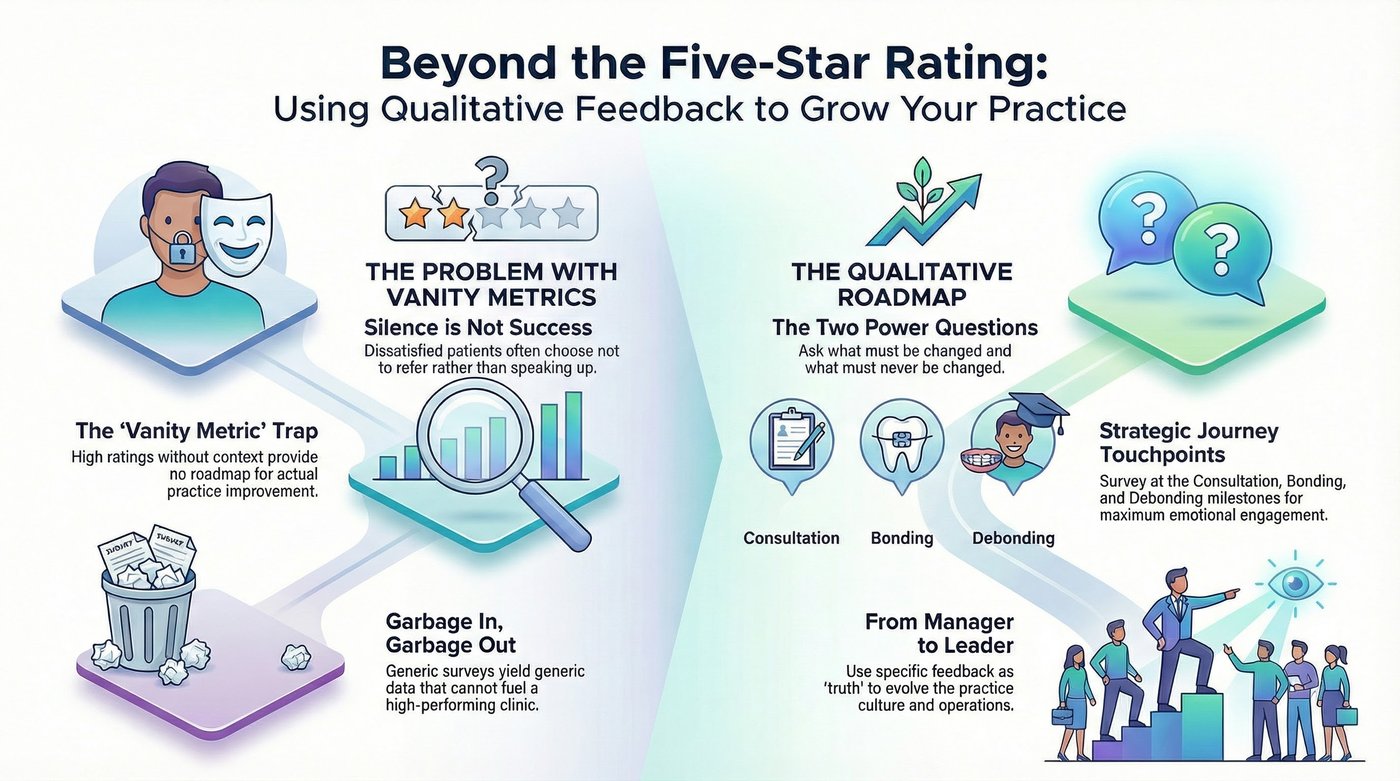
In the digital age, many dental and orthodontic leaders fall into the trap of “vanity metrics.” They see a high Google rating or a collection of five-star clicks and assume their practice is thriving. However, as a strategic leader, you must recognize that passive silence is not the equivalent of success. A stellar rating without underlying context provides zero roadmap for operational improvement or strategic resource allocation. To truly lead a high-performing clinic, you must move beyond generic box-ticking exercises and start intentionally collecting data that informs real change.
A truly professional approach to practice management requires treating patient satisfaction not as a marketing byproduct, but as a rigorous, ongoing internal study. Generic, quantitative surveys will only yield generic data—a classic case of “garbage in, garbage out.” If your goal is to unlock continuous operational excellence, you must shift your entire organizational focus from simple quantitative rankings to rich, qualitative insights that explain the why behind the numbers.
The Myth of the Happy Patient
It is a critical mistake for any practice owner to assume that a mere lack of complaints equates to a perfect patient journey. In reality, patients who are dissatisfied, or even just “neutral,” often find it too difficult or awkward to speak up in the moment. These patients rarely complain to the front desk; instead, they choose a silent form of protest: they don’t refer their friends, they leave less-than-enthusiastic reviews, or they simply seek their next complex treatment elsewhere.
To proactively break this cycle of silent attrition, you must actively “switch the lights on” across every patient touchpoint. You need to know not just if they are satisfied, but also the specific operational and emotional reasons. This requires moving definitively away from binary yes/no or “1 to 10” scales and toward carefully crafted, open-ended questions designed to reveal hidden friction points in your scheduling, technology use, or clinical communication processes.
The Power of Targeted Qualitative Inquiry
If you want truly actionable insights that lead to higher case acceptance and better retention, you must ask questions that actively force the patient to reflect and provide narrative detail. A generic prompt like “Rate your visit” provides zero utility. Practice leaders should deploy these two powerful, simple leadership questions at key moments:
“If there was one thing about your visit today that you could change, what would it be?” This question identifies the single biggest friction point that your leadership team might be blind to. This could expose anything from a confusing digital check-in process to an uncomfortable waiting chair or a perceived lapse in privacy by a team member. Targeting one change ensures the feedback is focused and executable.
“If there is one thing we must never change, what is it?” This identifies your unique, non-replicable value proposition—the specific behaviors or systems your team executes so well that they must be preserved and magnified. This could be the clinical assistant’s empathetic bedside manner or the clarity of the financial consultation.
By digging into the rich “why” behind the patient’s experience, you strategically move your practice operations from reactive guesswork to proactive, informed knowing. This intentional approach is the fundamental difference between merely being a functional manager and operating as a visionary, growth-focused practice leader.
Strategic Timing: Surveying the Journey, Not the Calendar
Most average practices hand out surveys based on a rigid calendar schedule—for instance, a generic “survey week” just twice a year. This approach yields low-quality, aggregated data disconnected from the patient’s immediate, specific experience. To secure high-quality, phase-specific data, you must strategically time your inquiry to moments where the patient’s emotional and operational engagement is highest:
After the initial consultation: Assess if they felt fully heard and if the treatment plan clarity was sufficient for high case acceptance rates.
After bonding or appliance delivery: Inquire about the transition into active treatment. Was the patient prepared for discomfort? This feedback directly impacts compliance and emergency appointments.
After debonding or treatment completion: This critical point measures the ultimate perceived value. Was the final result worth the investment and the journey? This is the primary driver of strong referrals and testimonials.
By tying your qualitative inquiry to specific, emotional milestones in the patient journey, you receive hyper-relevant data pertaining directly to that single phase of care. This targeted feedback allows your leadership to pinpoint exactly where specific systems are succeeding and where critical training or procedural adjustments are immediately required for better outcomes.
Conclusion: Turning Feedback into Leadership Capital
As a practice owner and leader, your most valuable asset for sustainable growth is the unvarnished truth about your service delivery. Whether that truth arrives in the form of high, specific praise or a stinging, detailed complaint, this qualitative feedback is the indispensable fuel for your practice’s continuous evolution. When you make the deliberate choice to stop chasing transient “stars” and start strategically chasing deep operational “insights,” you cultivate a durable culture of transparency, accountability, and clinical excellence that your quantitatively-focused competitors simply cannot replicate. This is how you transform raw patient opinion into lasting leadership capital and cement your reputation as a premium provider in the marketplace.