

Beyond Aligners: Building Clinical Authority through Comprehensive Orthodontic Expertise
Published on: Jun 24, 2026
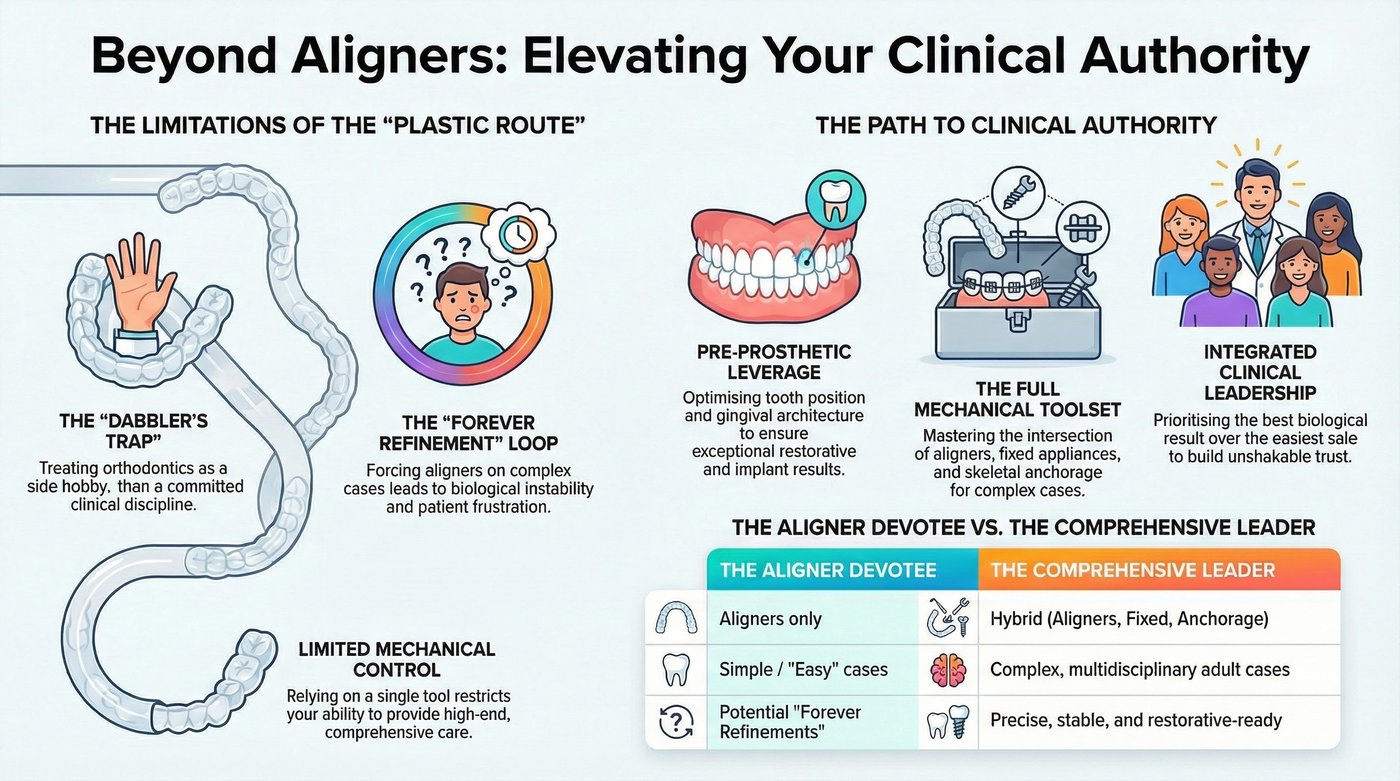
For many general dentists, the entry point into orthodontics is the “plastic” route. Aligners are marketed as the easy, user-friendly way to move teeth without the perceived complexity of fixed appliances. However, a lean leader quickly realizes that relying solely on one tool limits their ability to provide high-end, comprehensive care. To truly transform your practice, you must move from being a “plastic devotee” to a true orthodontist who commands a full suite of mechanical tools.
The singular reliance on aligner mechanics often leads to a lack of precise control over root torque, vertical dimension, and severe rotational corrections—limitations that compromise treatment predictability in complex cases. Mastery involves understanding not just how to use appliances, but when to transition between them for maximal efficiency and biological response. Incorporating fixed appliances and temporary anchorage devices (TADs) is the differentiator that enables non-surgical correction of complex skeletal issues. This comprehensive approach is what defines a prestigious, multidisciplinary clinic capable of solving problems others refer out. This expertise is what builds unshakable trust with your patients and sets your practice apart as a center of clinical excellence.
The Pre-Prosthetic Leverage: Orthodontics for Better Restorative Results
The most valuable application of orthodontics in a multidisciplinary setting is often not just “straightening teeth,” but preparing the foundations for superior restorative work. Adult patients frequently present with tipped molars, crowded incisors, or collapsed vertical dimensions that make ideal implant placement or veneer preparation impossible.
Consider the posterior segment: a mesially tipped molar significantly reduces the bone available for an ideal implant position and introduces unfavorable forces on the final restoration. By mastering segmental mechanics, you can use fixed appliances or TADs for controlled uprighting, effectively “un-tipping” the tooth to restore proper occlusal plane and dramatically improve bone access for implant stability. Similarly, forced eruption can be used to drag root surface into the mouth, allowing for ideal crown lengthening and optimizing gingival symmetry for aesthetic cases—a fine-tuning step that aligners alone struggle to achieve reliably. When you have the capability to handle these complex alignments yourself, you ensure that the final prosthetic result is not just good, but exceptional, benefiting from optimized bone and soft tissue architecture. This synergy is the hallmark of a high-end practice.
Honest Communication: The Authority of the Full Toolset
There is a significant psychological benefit to being proficient in both aligners and fixed appliances. When a patient arrives asking for aligners, but their biological and mechanical needs dictate otherwise, an undertrained dentist might try to force the aligners to work, leading to a “forever refinement” loop and patient frustration. This pursuit of a non-ideal solution often results in extended chair time, increased costs, and eventual patient disappointment, damaging the clinic’s reputation.
A lean orthodontist, however, can look the patient in the eye and present a treatment plan rooted in biomechanical certainty. For example, for a patient with a severe skeletal deep bite or significant transverse discrepancy, you can assert: “For your specific goal, aligners alone will not provide the stability or necessary skeletal changes. However, we can use a hybrid approach or fixed appliances to ensure a perfect, predictable result.” This level of honest clinical clarity, backed by actual capability, creates immediate, unshakable authority. You transition from being a product salesperson to a trusted clinical leader. Patients value a doctor who prioritizes the best long-term outcome over the easiest, quickest sale, leading to higher case acceptance for complex, high-fee treatment plans.
Avoiding the “Dabbler’s Trap”
The “Dabbler’s Trap” is the tendency to treat orthodontics as a side hobby, only accepting simple Angle Class I cases with minor anterior crowding. In the framework of Lean Orthodontics, we know that excellence requires structural commitment and deep education. You cannot achieve specialist-level results by only taking the “easy” cases.
True mastery requires passion for the details of biomechanics, including meticulous records, comprehensive diagnostics, and the ability to manage complications like root resorption or periodontal breakdown. For the clinic leader, structural commitment extends beyond clinical skill; it involves dedicating resources to proper inventory for both systems, ensuring staff is trained for fixed-appliance management, and allocating time for advanced case review. Investing in a structured educational path, whether through a university master’s program or a comprehensive in-office mentoring system, represents the highest ROI activity available. This commitment is about building a practice culture based on pattern recognition and risk mitigation, which drastically reduces chair-time emergencies, boosts workflow efficiency, and provides a level of comprehensive, high-end care that few competitors can match.
Conclusion: The Integrated Future
The future of dentistry is not in isolated silos but in the seamless integration of specialties. By mastering orthodontics within your multidisciplinary framework, you create a clinic that is more resilient, more profitable, and far more clinically capable. This integration transforms the general dentist into a Comprehensive Care Provider, managing the entire patient journey from skeletal foundation to final restoration. Stop referring away your most interesting and complex cases—they are the cases that build your reputation and expertise. Build the structure, train your team, and become the comprehensive leader your community and patients are looking for.