

Beyond Alginate: The Lean Strategy for Intraoral Scanning and Digital Documentation
Published on: Jun 27, 2026
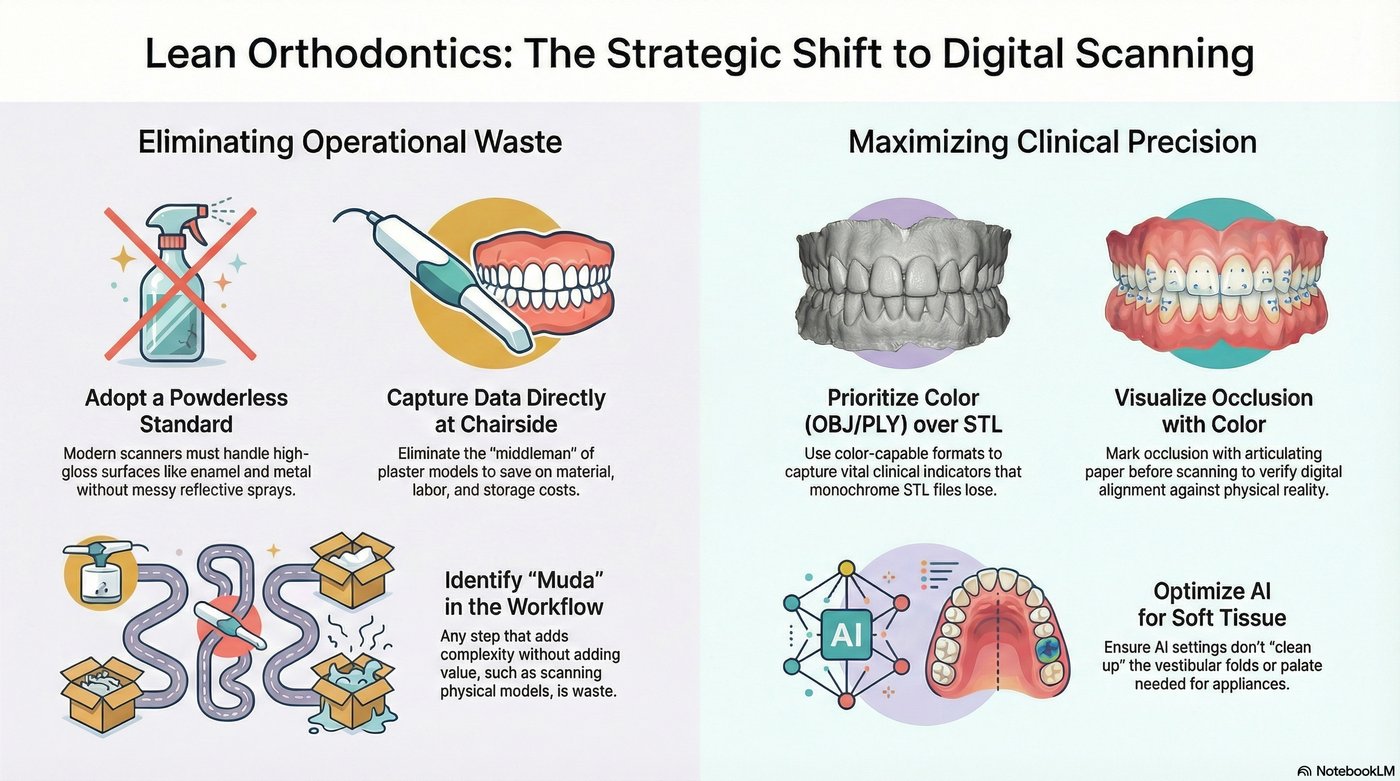
In the evolution of orthodontic practice management, the transition from analog impressions to digital scanning is often framed as a simple upgrade in equipment. However, viewing an intraoral scanner as just a “fancy gadget” to replace alginate is a fundamental error. In the framework of Lean Orthodontics, scanning represents a total shift in how we capture, process, and legally document the reality of our patients.
To master this revolution, clinic owners must move beyond the “which scanner is best” debate and focus on strategic integration. A lean approach to scanning isn’t about the hardware alone; it is about eliminating redundancy, maximizing data accuracy, and ensuring that your digital assets serve the clinical and administrative needs of a modern practice.
Eliminating Process Waste: The Powderless and Soft-Tissue Standard
From a lean perspective, any unnecessary step in a workflow is considered waste (“Muda”). For years, digital scanning required the use of titanium dioxide powder to manage reflections. In a modern clinic, this is an obsolete step. Using powder is messy, uncomfortable for the patient, and adds a layer of complexity that slows down the appointment. A lean-optimized scanner must be able to handle high-gloss surfaces—such as enamel, gold crowns, and metal brackets—without artifacts and without the need for sprays.
Furthermore, the “orthodontic scan” differs significantly from a “prosthetic scan.” While a dentist may only need the margins of a preparation, an orthodontist requires the vestibule and the palate for functional appliance fabrication.
A common pitfall is the scanner’s internal Artificial Intelligence. Many systems are programmed to automatically “clean up” soft tissue like cheeks and tongues. If your settings are not correctly toggled for orthodontics, the AI might delete the very vestibular folds you need for a functional appliance. Leadership in a digital clinic means training your team to understand these technical nuances, ensuring the data captured is usable the first time, every time.
The Myth of the Model Scanner: Avoiding Digital Redundancy
A frequent mistake in practice growth is the purchase of a model scanner to digitize existing plaster models. Let’s be clear: scanning a physical model is not digitalization; it is simply adding a digital step to an analog process. It is the definition of redundancy.
The only true lean solution is capturing data directly in the mouth. This eliminates the cost of impression materials, the labor of pouring plaster, the physical space required for storage cabinets, and the logistics of shipping. If your goal is operational excellence, bypass the middleman of plaster entirely and invest in the proficiency of your team at the chairside.
Color as Data: Moving Beyond STL Files
In technical circles, the STL file is the standard, but for the expert clinician, it is an outdated, monochrome format. STL provides the shape, but it loses the color. In lean orthodontics, color is not just an aesthetic choice; it is critical data.
By using color-capable formats like OBJ or PLY, you can capture vital clinical indicators. A high-value technical tip is to mark static occlusion with articulating paper before you scan. A high-quality scanner will capture these marks in color, allowing you to verify in the software if the digital occlusion matches the patient’s physical reality. This eliminates the “habitual occlusion” guessing game and ensures that your digital treatment planning is built on a foundation of absolute precision.
Conclusion
In conclusion, transitioning to intraoral scanning represents a total strategic shift within the Lean Strategy framework, moving far beyond a mere equipment upgrade. By focusing on eliminating process waste through powderless scanning, avoiding the digital redundancy of model scanning, and maximizing data accuracy with color formats like OBJ and PLY, practices can achieve unprecedented precision. This lean approach ensures that digital documentation serves as a robust foundation for modern, efficient, and high-quality orthodontic care.