

Beginning with the End: Planning for Stability from Day One
Published on: Jul 1, 2026
The Illusion of the Fast Finish
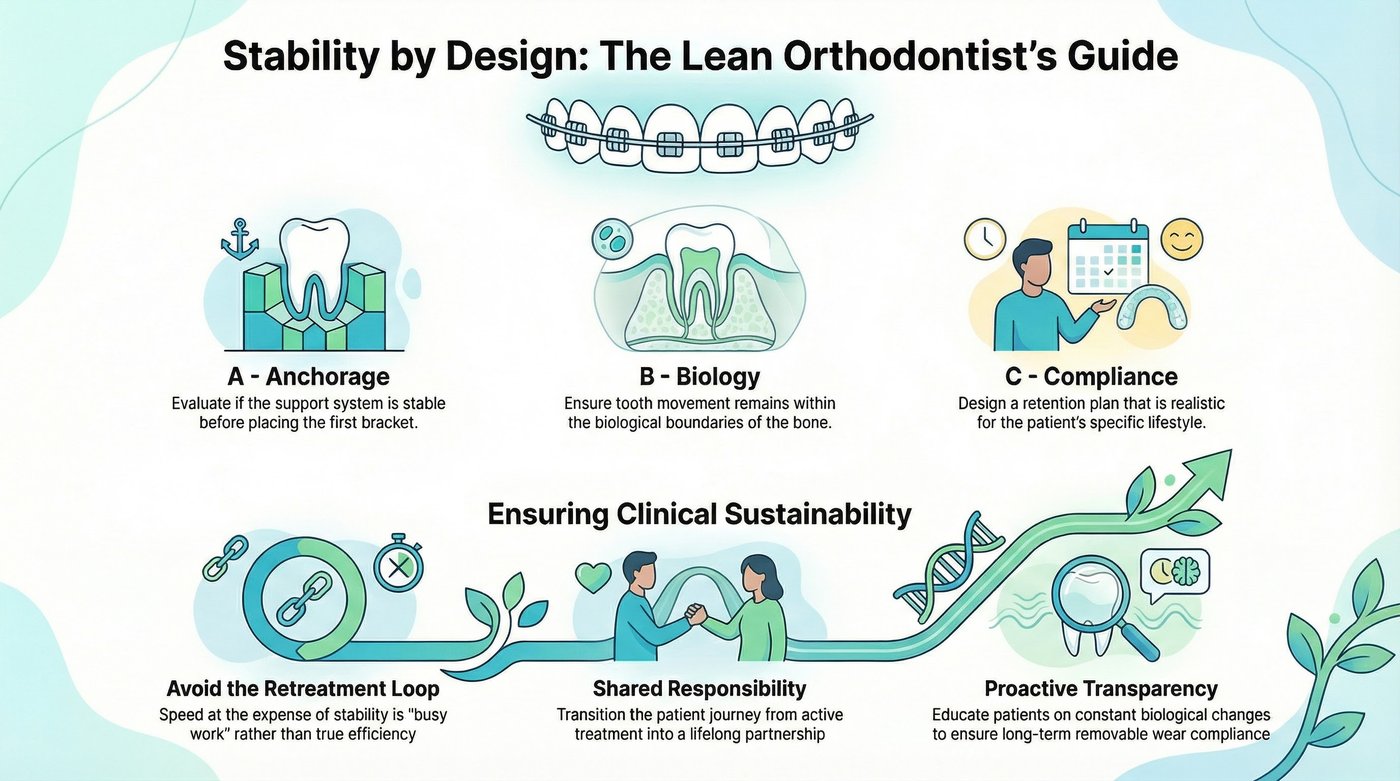
In a competitive market, it is tempting to focus on the fastest treatment path. However, speed at the expense of stability is a form of waste. This short-sighted approach, driven by patient demand for quick results, often undermines the long-term credibility of the practice. In lean management in dentistry, we evaluate the “sustainability” of a treatment method before we even place the first bracket. A lean process identifies and eliminates any activity that does not contribute to a stable, high-quality final result.
For example, if a specific distalization device or expansion technique is known for high relapse rates, it is not a lean solution, regardless of how quickly it moves teeth. The true cost of treatment must include the probability of post-retention complications and the time required for subsequent retreatment. Retreatment consumes valuable chair time, impacts staff morale, and erodes the patient’s trust in the initial investment.
True practice efficiency means avoiding the retreatment loop. Consider the clinical time spent on complex biomechanics; if you intrude molars by several millimeters only to have them extrude again during retention, the initial effort was “busy work” rather than a sustainable clinical outcome. Leaders in high-performing clinics understand that a few extra weeks of active treatment to achieve supra-crestal fiber reorganization is an investment in long-term stability and profitability. We must choose methods that work with biology, not against it, prioritizing orthopedic change and root position over simple crown alignment. This foundational philosophy defines a successful and ethical practice.
The ABCDE Planning Method for Success
To ensure long-term results, we use the ABCDE planning system. This disciplined approach forces us to calculate the probability of success after the treatment ends, shifting the focus from debonding day to five years post-treatment. Implementing this structured clinical checklist elevates the standard of care across the entire team, reducing reliance on individual practitioner experience alone.
A – Anchorage: Is the support system stable? Beyond assessing conventional anchorage methods, modern planning must incorporate the use of temporary anchorage devices (TADs) to truly guarantee stability in complex movements. A stable anchorage system ensures that desired tooth movement occurs without unwanted reciprocal effects that introduce instability elsewhere in the arch.
B – Biology: Are we pushing the teeth outside the biological boundaries of the bone? This requires a careful analysis of the patient’s periodontium and buccal-lingual bone plate thickness. Movements that force roots against the cortical bone are inherently unstable and often result in significant gingival recession or mobility during retention. Clinicians must respect the biological envelope to ensure longevity.
C – Compliance: Is the retention plan realistic for this specific patient’s lifestyle? A busy college student may struggle with full-time retainer wear, requiring a more robust fixed retention protocol combined with nightly removable appliances. Evaluating patient motivation and lifestyle factors upfront allows us to select a retention strategy designed for maximum long-term adherence.
D – Diagnosis of Relapse Factors: Have we identified and mitigated specific pre-existing risk factors such as strong tongue thrust, habitual mouth breathing, or severe mandibular growth rotations? If a pre-treatment skeletal or muscular discrepancy remains, the prognosis for stability is compromised. Comprehensive planning mandates addressing the underlying functional etiology, not just the symptomatic malocclusion.
E – Evaluation of Occlusal Endpoints: Does the finished occlusion demonstrate optimal intercuspation and canine guidance? A lack of solid, mutually protected occlusion creates inherent instability, as forces during function cause continuous, disruptive tooth movement. Finishing a case with precision—achieving Class I molar and canine relationships with tight interproximal contacts—is the final safeguard against relapse.
By aligning our diagnosis with the reality of stability, we minimize the “clinical ballast” of unexpected tooth movement. This proactive leadership ensures that every case we finish remains a walking advertisement for the quality of our practice, enhancing our reputation among referring dentists and prospective patients.
Transferring Responsibility to the Patient
Sustainability in orthodontics is a partnership. The patient journey doesn’t end at debonding; it enters a new phase of shared responsibility that must be clearly defined by the practice. Clear, consistent communication about the “lifelong” nature of retention is vital, presented not as a burden, but as a necessary maintenance routine—like servicing a luxury car. When patients understand that their biology is constantly changing due to factors like aging, normal attrition, and parafunctional habits, they are more likely to comply with long-term removable wear.
The most effective practices integrate retention education from the very first consultation, reinforcing the concept that the retention appliance is the most critical appliance they will ever wear. Documenting the patient’s agreement and compliance expectations is a powerful risk management strategy. This transparency reduces future friction, minimizes the uncomfortable conversations about relapse, and builds a community of satisfied, stable patients.
By making retention a core part of your dental team performance and patient education, you turn a potential clinical headache into a pillar of your practice’s success. Train your hygienists and clinical assistants to reinforce the retention message during every recall visit, making it a habit, not an afterthought. A dedicated retention protocol, complete with automated follow-up reminders, transforms the final phase of treatment from a clinical endpoint into a profitable, recurring recall system.
Conclusion: Excellence That Lasts
A beautiful smile is only as good as its stability. By choosing stable treatment methods—rooted in sound biological principles and lean management—and implementing a rigorous, patient-centered retention protocol, you lead your practice toward a future of high-quality results and minimal rework. This commitment to excellence translates directly into higher case acceptance, stronger word-of-mouth referrals, and greater professional satisfaction. This is the ultimate goal of the lean orthodontist: to create lasting change that survives the test of time, proving that stability is the only true measure of clinical success.