

Authentic Sales: Why Communicating Value is a Clinical Duty
Published on: Jun 27, 2026
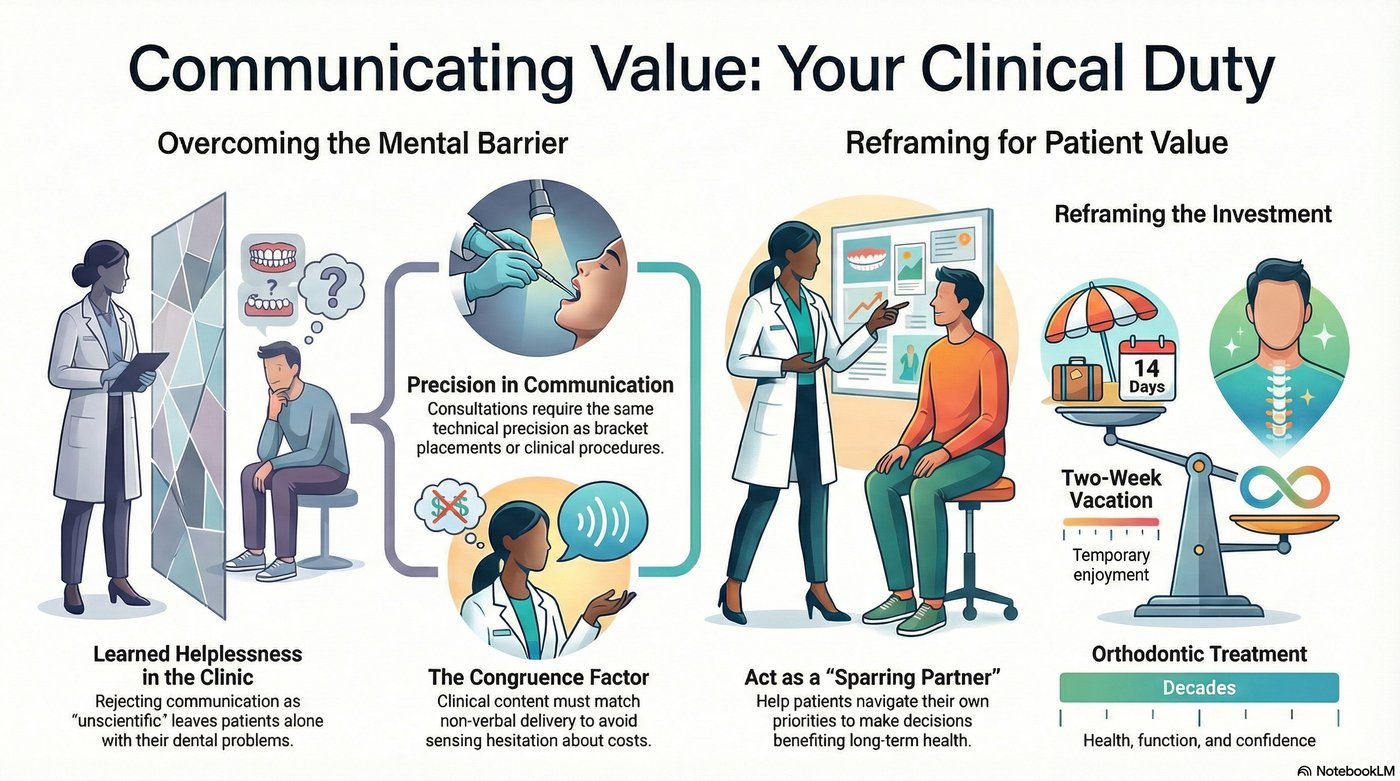
Overcoming Learned Helplessness
Many orthodontists recoil at the word “sales,” believing it to be unscientific or manipulative. We tell ourselves, “I am a clinician, not a salesperson.” In lean orthodontics, we call this a form of learned helplessness.
This professional hesitation often stems directly from clinical training that focuses heavily on mechanical mastery and biological processes while completely neglecting the equally crucial discipline of patient communication and motivation. This creates a gap between clinical recommendations and patient acceptance.
If you convince yourself that targeted communication is beneath your professional standing, you are essentially leaving your patients alone with their problems. The patient walks out of the consultation room, overwhelmed by the clinical complexity and focused purely on the sticker price, not the promised outcome of systemic health improvement. This is a significant breakdown in the continuity of care that the clinician is obligated to manage.
Every time you explain a complex procedure, you are communicating with a goal. That goal is not just intellectual understanding; it is fostering commitment to, and full compliance with, the prescribed treatment plan. A patient who declines optimal treatment due to poor value communication represents a clinical failure, regardless of the quality of the technical recommendations made.
If you don’t treat that consultation with the same precision you apply to a bracket placement, you are being an amateur in your management. Targeted communication must follow a clear, predictable structure, ensuring that the patient grasps the severity of their current condition and the long-term, irreversible benefits of intervention. This requires the same level of diagnostic skill applied to the verbal realm as is applied to radiographic analysis.
Behind every set of teeth is a person who needs to be understood. Targeted communication is not about “tricks”—it is the extension of your professional expertise into the verbal realm to ensure the patient receives the care they need.
By mastering this verbal extension, clinic leaders not only improve patient outcomes but also mitigate the risk of patients settling for inadequate, high-risk alternatives, ultimately protecting both the patient and the practice’s long-term ethical standing. The responsibility for patient health extends beyond the chair.
The Congruence Factor
Authenticity is the state of congruence: when your clinical content matches your non-verbal delivery. Congruence is a critical leadership competency, composed of three interlocking elements: clarity in diagnosis, sincere, unshakeable belief in the proposed clinical outcome, and a confident, unapologetic presentation of the investment required.
When these three elements align seamlessly, the patient perceives absolute integrity, confidence, and professionalism from the practice. If you feel uncomfortable discussing a high-value treatment because you’ve made a “pocketbook assumption” (assuming the patient can’t afford it), they will sense your hesitation.
This subconscious conflict is registered immediately by the patient, signaling to them that even the expert lacks full confidence in the proposition or its associated cost. This internal conflict is a massive waste of talent and revenue, creating an unnecessary barrier to beneficial treatment.
A lack of congruence results in lower case acceptance rates and, crucially, erodes the internal belief system of your clinical and administrative team. The clinical leader must set the standard: if the doctor does not believe in the fee structure as genuinely commensurate with the life-changing value delivered, the team cannot successfully communicate or defend it, leading to widespread practice frustration.
To be a lean leader, you must believe in your offering. This conviction must be so profound that the discussion of investment becomes a natural, unemotional, and necessary conclusion to the discussion of health and optimal function. Investing in structured team training through dedicated role-playing—where staff practice articulating the value proposition with genuine conviction—is a core management duty that drives financial health.
If you know your treatment will change a patient’s quality of life, then presenting the investment is an act of genuine concern. You are acting as a “sparring partner,” helping them navigate their own competing priorities so they can make a decision that benefits their long-term health. This partnership approach shifts the dynamic from a simple transactional exchange to a shared commitment focused on achieving permanent health equity.
Reframing the Investment
As experts, we must help patients adjust their perspective through Reframing. Reframing is a powerful cognitive technique that repositions the perception of treatment cost from a short-term, discretionary expenditure to a long-term, guaranteed asset, dramatically increasing its perceived Return on Investment (ROI).
A patient might hesitate to spend $6,000 on their teeth while happily spending the same on a two-week vacation. This cognitive discrepancy exists because the short-term, instant gratification frame is often psychologically far more compelling than the distant, long-term health frame. It is the professional’s duty to consciously and expertly correct this fundamental cognitive bias in the consultation.
We must clearly and unapologetically articulate the two opposing frames in the patient’s mind:
The Vacation Frame: 14 days of enjoyment, then it’s gone. A purely ephemeral, depreciating expenditure that offers no lasting functional benefit.
The Orthodontic Frame: Decades of optimized function, superior health, and deep confidence. An investment that accrues undeniable value in improved health metrics, psychological well-being, and professional presentation.
Clinic leaders must expand this comparison further, reframing the monthly investment in orthodontics against common recurring expenses, such as comparing it to high-end coffee habits or ongoing luxury subscription services. Furthermore, reframe prophylactic treatment, such as early interceptive orthodontics, not as an immediate cost but as a guaranteed avoidance of far more expensive and invasive surgical procedures in their adult years.
This shifts the conversation from current cost to proactive risk mitigation and long-term financial foresight. By highlighting this contrast with conviction, you provide the discourse necessary for the patient to make a smart choice. The use of compelling visual aids, such as before-and-after diagnostic photos or brief, genuine patient testimonials detailing life transformation, is essential to anchoring this newly reframed narrative.
You aren’t forcing a decision; you are providing the intellectual framework for a lifetime of value. Ultimately, effective communication of value is not a marketing gimmick; it is an intrinsic part of clinical governance, ensuring patients utilize your expertise to secure the highest level of health and function for their future. This commitment to verbal clarity is a non-negotiable standard of modern clinical excellence and leadership.
Conclusion:
The shift from mechanical technician to value communicator is the definitive hallmark of modern clinical leadership. It is not enough to possess superior clinical skill; the ability to translate that skill into clear, motivating, and congruent patient dialogue is equally critical. For clinic leaders, this means systematically embedding value articulation into the practice’s standard operating procedure. By treating patient consultation as a vital clinical phase, and by mastering the art of reframing, you fulfill your highest professional obligation—ensuring patients receive and commit to the optimal care they deserve. This is how high-performing practices achieve true clinical and financial congruence.