

Accelerating Through the Backlog: The “Traffic Jam” Theory of Patient Throughput
Published on: Jun 22, 2026
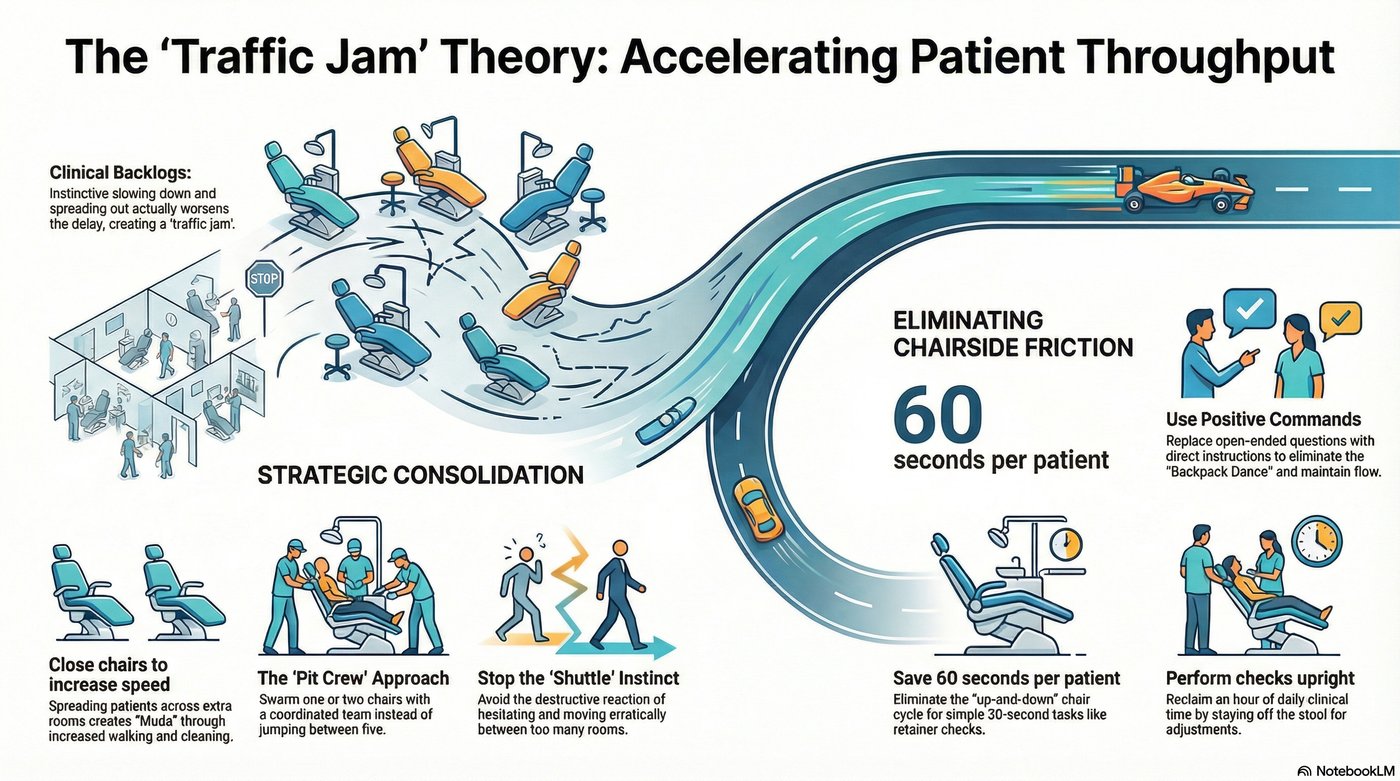
In the high-pressure environment of a busy orthodontic clinic, a crowded waiting room is often met with a predictable, yet destructive, human reaction. When the team sees a “traffic jam” of patients, they instinctively “hit the brakes.”
They slow down, begin to hesitate, and start “shuttling” between too many rooms at once, trying to appease everyone but finishing nothing. From a lean management perspective, this instinctive reaction is exactly what causes the chaos to spiral out of control.
This psychological “freezing” happens because the cognitive load of seeing ten waiting patients becomes heavier than the task at hand. Instead of focusing on the single clinical objective, the mind wanders to the backlog, creating a feedback loop of inefficiency and mounting stress.
I am Dr. Martin Baxmann, and to master practice efficiency, we must look at the highway for a solution. When drivers brake erratically at the first sign of congestion, they create shockwaves that turn a minor delay into an hours-long standstill.
To clear a bottleneck in your practice, you must do the exact opposite of what feels natural: you must stay in your lane and accelerate through the jam. This means maintaining a steady, rhythmic pace rather than frantic, stop-start bursts of energy.
Leadership in this moment is about maintaining the “flow state.” By projecting calm and executing tasks with precision, you signal to your team that the situation is under control, preventing the emotional contagion of panic from slowing down the clinical floor.
The Myth of the “Extra Chair”
When a backlog occurs, many practice owners think the solution is to open more treatment rooms. They believe that by spreading patients across five chairs, they are “getting ahead” by making patients feel “seen” sooner.
In reality, this creates massive amounts of “Muda” (waste). Every extra room opened requires setup, breakdown, and specific environmental controls. It dilutes the team’s focus and forces the doctor to walk hundreds of extra steps every single day.
For example, if a doctor spends just 30 seconds walking between distant chairs for 50 patients, that is 25 minutes of pure transit time—time that could have been spent on three additional high-value consultations or complex adjustments.
True lean leadership dictates that you consolidate rather than expand. Instead of opening more chairs, you should close them. By swarming one or two chairs with a highly coordinated team, you increase your actual throughput.
It is the Formula 1 “Pit Crew” approach: you don’t have one person running around the car; you have specialized individuals performing singular, lightning-fast tasks in a synchronized dance around the patient.
When you work in a “power block” of adjacent chairs, communication becomes instantaneous. You can delegate the scanning, the cleaning, and the documentation without ever losing line-of-sight of the next patient, keeping the momentum moving forward.
Eliminating “Mechanical Waste” at the Chairside
A significant amount of time in an orthodontic appointment is consumed by what I call “mechanical waste.” This is the time lost to equipment movement rather than clinical care. Consider the simple act of adjusting a chair.
Raising and lowering a dental chair, waiting for the motor to whine to a stop, and positioning the headrest takes approximately 60 seconds. For simple tasks—such as a retainer check or a removable appliance adjustment—this is completely unnecessary.
In a lean practice, we categorize every movement. If the task does not require the patient to be supine for visibility or access, the chair should remain stationary. This small change respects the patient’s time as much as your own.
If you have ten patients backed up and you watch the chair move up and down for every one of them, you have just wasted ten minutes of clinical time. A lean clinician performs these checks with the patient seated upright.
Walk in, greet them, perform the check, provide the instruction, and walk out. By eliminating the “up-and-down” cycle and not sitting down on your own stool for 30-second tasks, you reclaim the minutes that eventually accumulate into an hour of saved time per day.
Imagine the financial impact: saving one hour daily across a four-day work week allows for roughly 16-20 additional short appointments or 4 major bondings monthly without adding a single minute to your staff’s workday.
The “Backpack Dance” and the Power of Positive Commands
Bottlenecks are often exacerbated by the “friction” of patient movement. We have all seen the “Backpack Dance,” where a teenager takes two minutes to remove a jacket, put down a bag, and stow a phone before finally sitting.
This friction acts like sand in the gears of your practice. If every patient delays the start of their treatment by 90 seconds due to personal logistics, a schedule of 40 patients loses an entire hour just to “settling in.”
Lean workflows require clear zones for belongings so the patient can transition from the hallway to the chair in seconds. This physical environment design is a silent partner in your practice’s overall throughput strategy.
To maintain flow, the lead clinician and the team must take immediate control of the interaction. Replace open-ended questions like “How are you doing today?” with clear, positive commands: “Please sit down. Head back. Open wide.”
This isn’t about being rude; it is about professional leadership. It guides the patient through the process efficiently, ensuring the clinical work remains the focus and the schedule stays on track while maintaining a high standard of care.
Positive commands reduce patient anxiety by removing ambiguity. When a patient knows exactly what to do next, they move faster and feel more confident in your expertise. You are the pilot of the appointment; lead with authority and kindness.
Conclusion: Mastering the Flow
The “Traffic Jam” theory teaches us that efficiency is not found in doing more things at once, but in doing the right things with singular focus. By resisting the urge to spread thin and choosing to accelerate through the backlog, you transform your practice.
Eliminating mechanical waste, adopting a pit-crew mentality, and leading with positive commands are the hallmarks of a truly lean orthodontic leader. Implement these changes, and you will find that the “traffic jam” dissolves, leaving behind a productive, calm, and profitable clinic.