

24-Hour Production: Why 3D Printing is the Engine of the Modern Practice
Published on: Jul 2, 2026
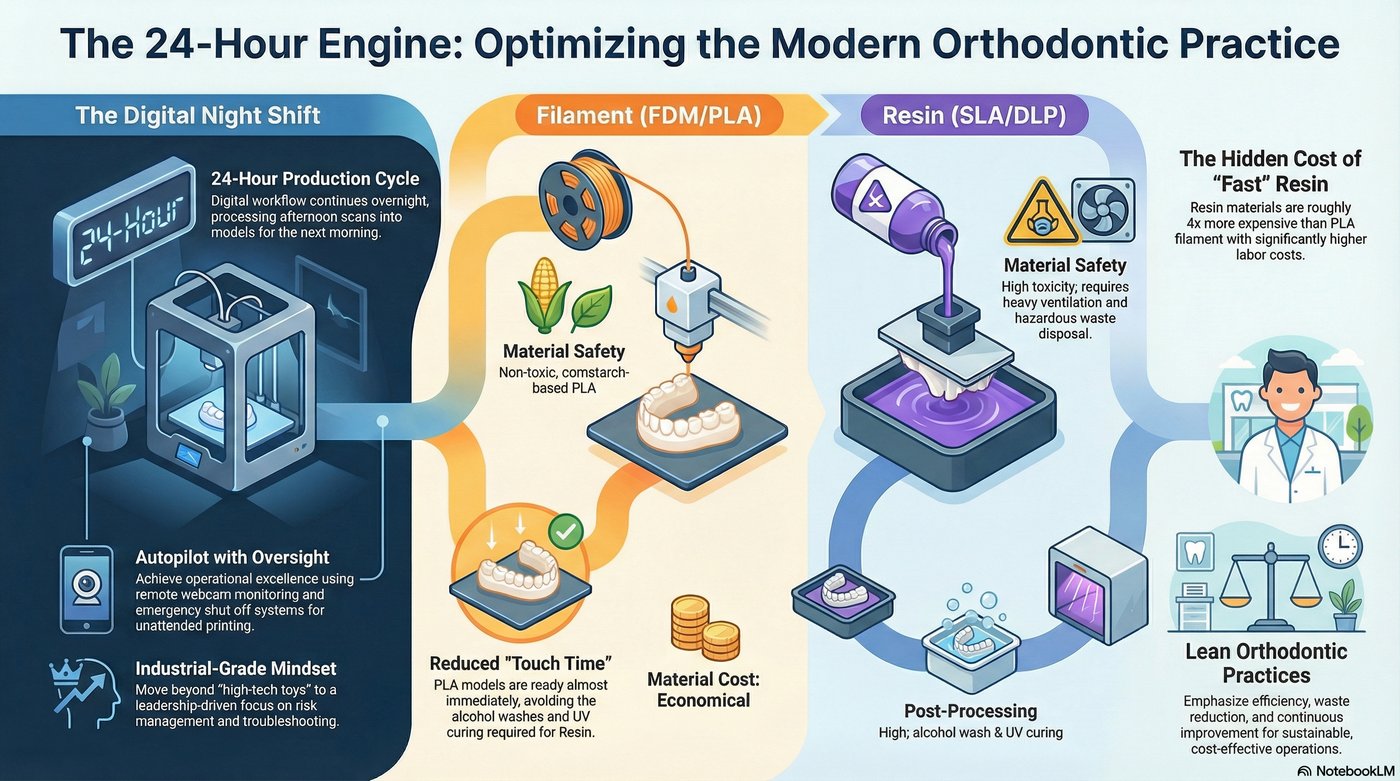
The Digital Night Shift
In a traditional orthodontic lab, production stops the moment the staff goes home, creating a bottleneck that delays patient care. In a lean practice, the end of the clinical day is simply the transition to the next production cycle. This shift in mindset transforms your office into a high-output facility that generates value while the lights are off.
One of the greatest advantages of lean orthodontics is that your digital workflow operates on a 24-hour clock. A 3D printer can process the afternoon’s intraoral scans, delivering a full bank of precise models by the following morning. This allows your team to arrive at a lab that is already “stocked” with the day’s requirements, moving immediately into appliance fabrication without the morning rush of pouring stone.
However, moving toward operational excellence means recognizing that these are industrial-grade machines, not just high-tech toys. Running machinery overnight unattended requires a leadership mindset focused on proactive risk management. For a practice to truly run on “autopilot,” you must implement robust safety infrastructures.
Consider practical solutions like remote webcam monitoring and smart-plug emergency shut-off systems accessible via smartphone. These tools ensure that a minor printing failure at 2:00 AM—such as a filament jam or a build-plate detachment—doesn’t escalate into a significant liability or a wasted day of production. Establishing these protocols is the difference between a chaotic digital transition and a controlled, scalable system.
FDM vs. Resin: Choosing Your Professional Workhorse
To maximize practice efficiency, clinical leaders must understand the two primary categories of 3D printing: filament-based (FDM/PLA) and resin-based (SLA/DLP). Both have distinct roles, but choosing the wrong “workhorse” for your specific volume can lead to unnecessary overhead and labor strain.
Filament (FDM): This method works like a high-precision spider spinning a web, building layers from a heated spool of PLA. It is highly valued in lean management because PLA is often based on cornstarch, making it a non-toxic, healthy material for the office environment. It requires minimal ventilation and produces less hazardous waste, aligning with modern health standards for both staff and patients.
Resin (DLP/SLA): These systems use light to cure liquid resin. While they offer a smoother surface finish, they introduce significant “administrative ballast.” The liquid resin requires careful handling, heavy-duty ventilation systems to manage fumes, and complex post-processing involving flammable alcohol washes and specialized UV curing stations. For many practices, the trade-off for surface aesthetics isn’t always justified by the increased maintenance.
The Hidden Costs of Speed
While resin-based DLP printers are faster for mass production—as they flash an entire layer at once regardless of the number of models on the platform—the “hidden” costs are substantial. High-quality resins are roughly four times more expensive than PLA filament per unit. Furthermore, the labor-intensive nature of resin cleanup often negates the speed of the print itself.
In a high-volume orthodontic office, these costs add up quickly. A resin system requires constant monitoring of vat levels and regular replacement of delicate film liners. When you factor in the consumable costs and the specialized disposal requirements for chemical waste, the price-per-arch can climb significantly higher than expected, impacting your overall profit margins.
In a lean practice, we look at the total “touch time”—the actual minutes a staff member spends handling the model. A PLA model printed correctly is often ready for the patient almost immediately after removal from the build plate. There is no messy cleanup, no chemical baths, and no secondary curing process required before it can be used for vacuum-forming.
A resin model, conversely, requires washing in isopropyl alcohol, drying, and an extra 20 minutes in a UV curing oven. When you calculate the aggregate labor cost and the overhead of managing hazardous materials, the “fast” resin option often becomes the more expensive and less efficient route for standard orthodontic models. Efficiency is measured by the time it takes to go from scan to appliance, not just the speed of the machine.
Conclusion: Engineering a Crisis-Proof Lab
Implementing 3D printing is like maintaining a high-performance vehicle. It requires a team trained in basic troubleshooting so that when a machine stops, the clinical flow doesn’t stall. Leadership must ensure that the digital lab is not a “black box,” but a transparent, reliable system that every relevant staff member understands and can support.
By balancing production costs, material safety, and dimensional accuracy, you build a resilient digital lab that serves as the engine of your growth. This transition allows you to move away from the dusty, labor-heavy world of plaster and into a clean, precise, and highly profitable future. A well-engineered 3D printing strategy doesn’t just make models—it creates the capacity for your practice to thrive in a digital-first market.