

136A- Why _Harder_ Isn_t Always Better
Published on: Jun 7, 2026
The Success Paradox: Why “Harder” Isn’t Always Better
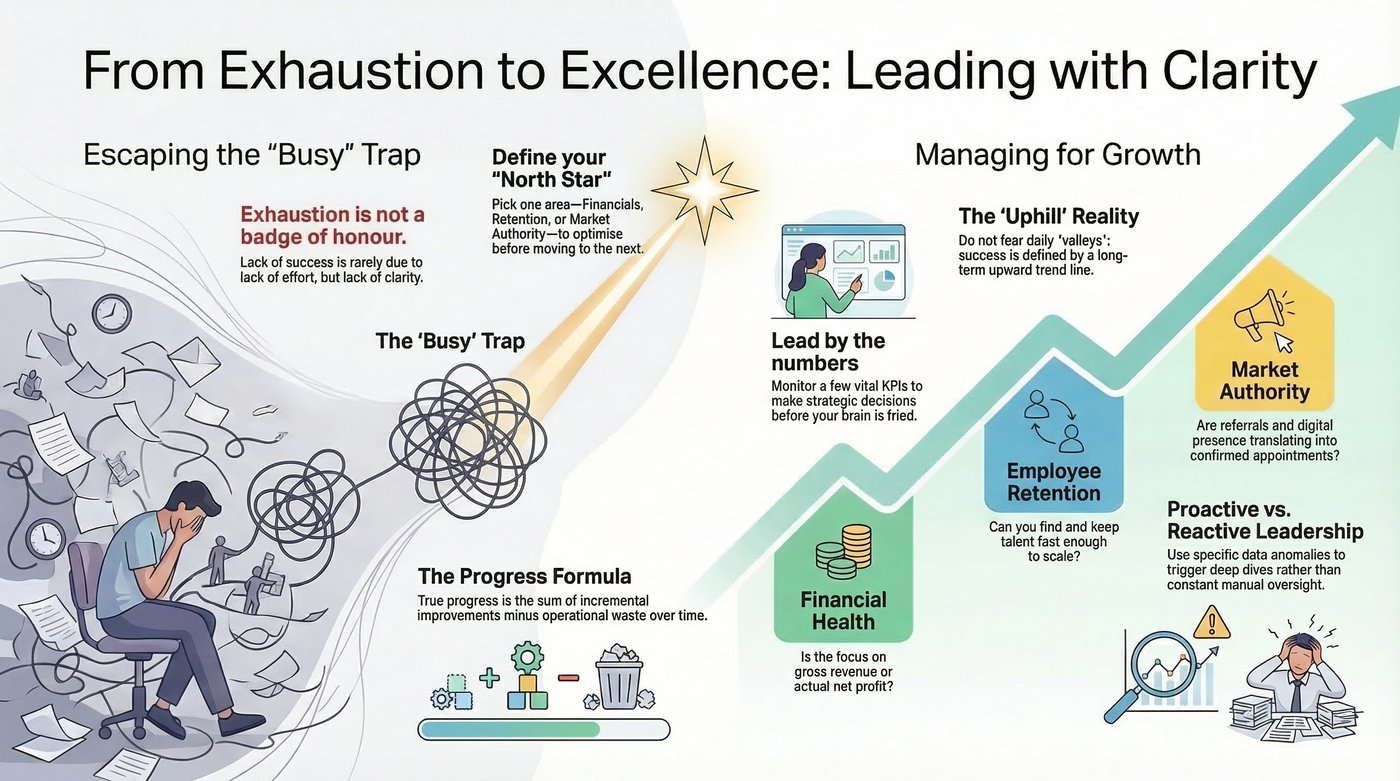
In the high-pressure world of orthodontics and dentistry, we are often conditioned to believe that exhaustion is a badge of honor. We assume that if we are sweating through our scrubs, skipping lunch, and leaving the clinic long after the last patient has departed, we must be succeeding. This “grind” mentality suggests that volume and effort are the primary drivers of growth.
However, as Dr. Martin Baxmann emphasizes, a lack of success is rarely a lack of effort—it is a lack of clarity. Many practitioners find themselves running a “hamster wheel” practice: high energy, high stress, but stagnant net results. When you feel stuck in a cycle of clinical fatigue or plateaued revenue, the solution isn’t to run faster or schedule more patients into an already broken workflow; it’s to stop and define exactly what you are running toward.
To achieve true operational excellence, we must move away from the “busy” trap—where activity is mistaken for progress—and toward a data-driven definition of success. This transition requires a shift from being a technician who happens to own a business to a CEO who leads a clinical organization with precision and intent.
Defining Your “North Star”
Success is not a singular destination; it is a multi-faceted balance that requires strategic prioritization. A common mistake for practice leaders is the “scattergun” approach to improvement. If you try to fix everything at once—revenue, staff turnover, referrals, clinical efficiency, and social media—you will stabilize nothing. Your energy is a finite resource; spreading it too thin results in marginal gains that are easily lost.
You must pick one “North Star” metric to optimize before moving to the next. For example, if your clinical flow is chaotic, focusing on marketing will only exacerbate your internal stress. Once one area is systematized and predictable, you gain the “bandwidth” to tackle the next. Consider these three foundational metrics as potential starting points:
Financial Health: Is your focus on gross revenue or actual net profit? A practice generating $2M with 75% overhead is less “successful” than one generating $1.5M with 50% overhead. High-level leaders prioritize margin over top-line vanity numbers.
Employee Retention: Can you find and keep talent fast enough to scale? The “cost” of a departing lead assistant isn’t just their salary; it’s the lost clinical efficiency and the months of training required for a replacement. A stable team is the engine of a quiet, profitable clinic.
Market Authority: Are your referrals and digital presence translating into confirmed appointments? Marketing isn’t about likes; it’s about conversion. If your “new patient starts” are lagging despite high lead volume, your friction point is likely in the consultation room or the front desk script.
The “Uphill” Reality of Progress
A common psychological trap for practice owners is the desire for an “easy” day where everything runs on autopilot. We feel that if things aren’t running smoothly on their own, or if a team member makes a mistake, we are failing. In reality, growth is an uphill climb. Friction is a natural byproduct of expansion. If you are not experiencing some level of operational tension, you are likely stagnant.
If you were to plot your success on a graph, the daily fluctuations would look like a series of peaks and valleys. One day, a bracket fails; the next, you close a record number of cases. The goal is not to eliminate the valleys, but to ensure the overall trend line is moving upward. We must learn to manage the “micro” failures without losing sight of the “macro” trajectory. Mathematically, we can view the long-term progress $P$ over time $t$ as:
$$P(t) = \int_{0}^{T} (I(t) – W(t)) dt$$
Where $I$ represents incremental improvements and $W$ represents operational waste. If the integral is positive over time, you are succeeding, even if today felt like a struggle.
Managing by the Numbers (Without the Headache)
Many specialists avoid their financial data because the reports from accountants are too dense to navigate, or they feel they lack the business background to understand them. However, you don’t need to be a CPA to lead your practice effectively. You only need to identify and track your Key Performance Indicators (KPIs).
Think of KPIs like the dashboard in your car. You don’t need to look under the hood while driving to know if you are running out of fuel or if the engine is overheating. You just need to see the gauges. For an orthodontist, these gauges might be “conversion rate,” “average production per visit,” or “days in accounts receivable.”
“If the few specific points I monitor are correct, we are on the right track. If I see an anomaly, then we dig into the details.” — Dr. Martin Baxmann
By focusing on a few vital statistics, you move from a reactive “firefighting” mode—where you only notice problems when the bank account is low—to a proactive leadership mode. This clarity allows you to make strategic decisions during the clinical day based on facts, rather than at $10:00$ PM when your physical and mental energy is depleted.
When you lead by the numbers, you remove the emotional weight of uncertainty. You no longer “feel” like the practice is doing well; you know it is. This is the foundation of a sustainable career that provides both financial reward and personal peace of mind.
Conclusion: Embracing the Lean Leadership Path
The success paradox teaches us that working “harder” often masks a lack of systemization. To break through the glass ceiling of your current performance, you must stop treating your practice like a series of emergencies and start treating it like a refined machine. By defining your North Star, accepting the necessary friction of growth, and managing through objective KPIs, you transform from a fatigued clinician into a thriving practice leader.
True excellence is found when your clinical skill is matched by your operational clarity. Don’t just work for your practice; make your practice work for you. The path to a better clinic isn’t paved with more sweat—it’s paved with better data and the courage to stop running long enough to fix the direction.